
Are you entertained by Sudoku and serial killers? Crosswords and crime? Then play detective and solve these entertaining puzzles! Alongside some of your favorite brain teasers are facts about infamous true crime cases. From word searches and encrypted messages to coloring Ted Bundy in court, the True Crime Activity Book will test your puzzle-solving skills and feed your need for true crime.
In line with Genius Books' philosophy, this book honors the victims and celebrates the heroes who fight for them.
These information documents for each of the official Trade Mark of Quality releases includes the known details for each genuine TMQ title. This includes the TMQ catalogue number, artist, record title, track list, musicians, venue, recording date, master tape and record matrix info and the other particulars for each album.
The solution to the Zodiac serial killer case is both clear and controversial. There's one man who fits the puzzle: a letter writer, bomb maker, and code creator who lived in the area during the Zodiac murders. He had easy access to the crime scenes and had a psychotic break around the time the Zodiac's terrible killing spree began. This man was not only a genius-level mathematician but also skilled at disguising his handwriting, leaving no fingerprints, and crafting incredibly difficult ciphers to tease the police and the public with his hidden identity. His name is Theodore J. Kaczynski.
Kaczynski was shaped by the MK Ultra project at Harvard University and became one of UC Berkeley's youngest math professors, a job he detested. He committed his first Zodiac murder during the winter break of 1968 and struck again just after resigning from his teaching position in July 1969. His criminal signature, which included writing letters and creating codes, continued in both his criminal careers as the Zodiac and Unabomber.
"EXPOSED" takes you through all the evidence presented in the first two books, "HUNTED" and "PROFILED," and methodically links the Zodiac and Unabomber cases using handwriting, codes, locations, literature, cultural references, and other unexpected details. It makes a compelling case that Kaczynski cannot be dismissed as the Zodiac, one of the most notorious serial killers in history. If you're a fan of crime thriller books, this is a gripping exploration of a controversial theory about the Zodiac killer's identity.
Paul McCartney Was Alive... But Would Anyone Believe It?
In the fall of 1969, a rumor swept across college campuses and airwaves: Paul McCartney of the Beatles had died in a car crash, and the surviving band members had replaced him with a double. Students and disc jockeys poured over album covers and songs claiming to uncover hidden clues. Headlines, radio shows, and late-night debates turned the rumor into a cultural phenomenon.
Turn Me On, Dead Man tells the story of how the “Paul-Is-Dead” hoax spread and why so many people believed it. From a phone call to a Detroit radio station, to a satirical review in The Michigan Daily that became front-page news, the book traces the rumor’s rapid rise. With careful research and rare material from newspapers, radio transcripts, and firsthand accounts, Andru J. Reeve reconstructs how a six-week frenzy convinced thousands that the Beatles were sending secret messages about their fallen bandmate.
More than a simple catalog of supposed “clues,” this book explores the rumor’s social and cultural impact. It examines why people were ready to believe, how the media fueled the fire, and what this phenomenon reveals about fame, rumor, and the power of storytelling in popular culture.
Detailed, witty, and grounded in historical evidence, Turn Me On, Dead Man preserves one of the strangest and most fascinating chapters in the history of rock music and mass media.
Baker Street is your ultimate guide to the enduring world of Sherlock Holmes. This comprehensive book explores the original tales by Arthur Conan Doyle, delving into the genius behind the legendary detective. From there, it ventures into the fascinating realm of pastiche novels, tracing their evolution from the early 1900s to the present day. Dive into Holmes’ cinematic journey, from silent-era experiments to today’s sophisticated adaptations, and discover how each era reimagined the detective and his loyal companion, Dr. Watson. A must-read for Holmes enthusiasts, Baker Street celebrates the literary and cultural impact of the world’s greatest consulting detective across generations and mediums.
Baker Street: The Curious Case Files of Sherlock Holmes is an 8.5x11 paperback with 284 full-color pages.
Imagine a chilly April morning in 1990. A woman walking her dog suddenly stops in her tracks, shocked and disturbed. What made her pause? A human skull blocking a drainage tile. It turns out to be the remains of Joan Webster, a 25-year-old Harvard graduate student who had been missing over eight years ago, leaving the community baffled and investigators puzzled.
The prosecutors had a suspect, Leonard Paradiso, who had been tried and convicted for another local woman's murder. The only connection between these tangled cases was that both victims had long, dark hair. Assistant District Attorney Tim Burke was determined to prove Paradiso guilty of both murders. However, with limited evidence and constantly changing stories, the circumstances surrounding Joan Webster's death remain a mystery to this day.
But there's hope. Joan's sister-in-law, Eve Carson, has relentlessly pursued her quest for justice. "Simple, Safe & Secret" reveals the disturbing details and flaws in the system that have hindered justice in solving Joan Webster's murder. The truth about the bungled investigation and the wrongful conviction may be even darker than the story of Joan's murder itself. If you're a fan of crime thriller books and crime mystery books, this is a story that will grip you from start to finish.
5.0from 1 reader
Chapter One
“Oh, Men of Dark and Dismal Fate”
The audience rose to their feet with thunderous applause as the ensemble reached the crescendo at the end of Act I. Joan tapped her gray shoes still humming “Oh, Men of Dark and Dismal Fate.” She loved the theater and the exhilaration of New York City. The empty seat next to her in the heaving playhouse was the only blight on her otherwise perfect evening of Friday, November 27, 1981.
As the curtain rose for the second act of The Pirates of Penzance. Joan settled back into her seat next to her parents and her sister, Anne. Their older brother, Steve, was half a country away, living in Illinois with his pregnant wife, Eve. Joan smiled, not daring to show her disappointment. Family logistics nixed the planned visit of her friend over the Thanksgiving break. The Websters organized their calendars down to the smallest detail. The shift in the schedule was out of character, but the adjustment set the stage for the dramatic chain of events about to unfold.
Joan’s father George nodded to the songs of Gilbert and Sullivan as the actors belted out uncanny premonitions in Act II. The comedic constables on the stage voiced a logical notion. When criminals were not engaged in their enterprise, they did normal things anyone might do. The players’ lyrics warned of impending despair, keeping the audience on the edge of their seats. Joan’s mother Eleanor thumbed the pages of her Playbill. Subliminal messages, delivered in an entertaining performance, reassured her everything was prepared. A swashbuckling troupe challenged the young actor on stage with a paradox when he left the fold. The verses held more meaning than Joan could have foreseen. The librettos projected a dismal fate for the lamb straying from the flock and the contradictions of her guardian.
When the curtain came down on the musical comedy, George, Eleanor, Anne, and Joan walked out of the Minskoff Theatre on W. 45th Street in New York City’s theater district. George played the soundtrack cassette in the car as he drove to a favorite watering hole for a nightcap. Cosmos knew George by name and gladly entertained his requests on the piano. Joan’s father gulped down his Scotch and placed a folded bill in Cosmos’ gratuity snifter. The patriarch subtly signaled to his brood; it was time to leave. Docilely, his entourage took their positions in the blue Buick station wagon. George turned into the Lincoln Tunnel headed for home turf in New Jersey.
The family entered the house through the garage door by the pantry. The girls headed upstairs for the night, and Eleanor settled in the den to watch the late news. George opened the liquor cabinet and poured another two fingers of Scotch. He carried the bottle to the den and placed it on the mirrored table beside him. His body gradually slid to an uncomfortable, half-reclined posture on the loveseat: his head tilted back, bobbing unsupported, and his spectacles askew. The guttural tone of George’s voice resonated as he mumbled and snored in a semi-conscious stupor. The pattern was familiar. Eventually, Eleanor nudged and coaxed her husband to bed.
The girls were already in place at the small kitchen table the next morning. George walked through the front hall and tapped the turtle’s tail announcing his presence. The turtle was a whimsical dinner bell, a symbol of the privilege of George’s upbringing. Eleanor busied herself dutifully in the kitchen. She moved to the table with George’s first course and a hot cup of coffee. As she sashayed through the kitchen, the itinerary tacked on the refrigerator rustled and reminded George to coordinate the day with his fledglings. His upcoming trip was uncharacteristic. As a senior executive with International Telephone & Telegraph (ITT) in Nutley, New Jersey, George would normally delegate rather than interrupt his holiday. The impending agenda demanded his personal attention. None but the person in charge could know the full purpose of his mission.
George went to the cupboard to add some libation to his second course. The Bloody Mary began the daily ritual of numbing his senses. He pushed up his wire-rimmed glasses to peruse the news of the day in the paper. Only an occasional grunt suggested a story caught his attention. He pushed away from the table and headed back upstairs while Eleanor played the scullery maid, clearing the dishes. Dark, sullen eyes stared back at George from the bathroom mirror. He ran his fingers through his thick, wavy mane before splashing on the hair tonic to slick back the curves.
Joan retreated to her room to pack her belongings. She folded the essentials she had brought home for the long weekend and tucked them neatly in her Lark suitcase. She tossed a single green sock in her bag hoping its partner was back at the dorm. She carefully wrapped the folded clothes around a stack of photographs, memories from the family’s summer vacation in Nantucket. When Joan opened her bedroom door, she heard the door across the hall shut tightly. Her bedroom sat across the hallway from George’s upstairs small study. She could hear her father’s low guttural tones talking on his private line as she pulled bed linens out of the closet to take back to school. That second line into the house sat on George’s desk and was off limits. It was the rule of the house not to disturb George in his office.
The baby of the family, with two older siblings, Joan was a 25-year-old student at the Harvard Graduate School of Design. Before returning to school, she lived in Manhattan for two years, working for Skidmore, Owings & Merrill. The independent student had even traveled alone through Europe. During her time in New York City, the petite young woman was the victim of a street crime when an assailant snatched her purse. She learned to be aware of her surroundings. As the dorm proctor at Perkins Hall, she passed along safety tips to the coeds she mentored. In her second year of graduate school, she was an excellent, award-winning student with a promising future.
On the Monday before the Thanksgiving break, Joan had presented an 11-week auditorium project to rave reviews before riding to New Jersey with her sister. It was disappointing her friend couldn’t come to visit as planned, but George’s trip over the weekend took precedence for the family. Rather than wait to ride back to Boston with Anne on Sunday, George made arrangements and scheduled a flight for Joan on Saturday night.
Eleanor announced that lunch was ready. George made his way back to the kitchen table, poured a glass of beef broth, and diluted the consommé with a shot of vodka. He confirmed that everyone knew the drill. The foursome would grab an early bite at the club before making the rounds and then drive Joan to Newark Airport. Everything was planned down to the minutest detail as if they had synchronized watches.
Joan collected a few last-minute items and stuck them in her leather carry-on tote bag. She added a few vinyl records from the musicals she enjoyed on Broadway, the Playbill from the night before, rolled up sketches and architectural pamphlets, and her pair of gray shoes.
The upper-middle-class family fit a finely tuned image. In public, the Websters embodied all the social graces to be on every guest list. Their credentials boasted all of the best schools and social connections. The charismatic men in the Webster family were engaging pied pipers. George and his son Steve often played the piano and entertained listeners with humorous tales. Irish wit and charm centered them in any gathering, and they relished the adulation. To the outside observer, they were a perfect family in complete harmony. Any hint of discord evaporated when the Websters opened the door from their inner sanctum.
Glen Ridge, New Jersey was a small hamlet near Manhattan. Families were close knit, and the children all grew up together. Vacations and holidays became community affairs. The Websters’ Georgian home was tastefully decorated, but a bit out of date. However, any connoisseur noticed the expensive paintings on the wall and the gold and silver trophies of prestigious regattas and thoroughbred victories at the track. A very large, round diamond on Eleanor’s finger fractured the light into a rainbow of color, brightening her otherwise bland attire. Wealth and status were an important part of the image but carefully displayed without being garish. George and his offspring all wore gold signet rings as if the circles identified exclusive membership in the clan.
George was the first to come down the curved staircase prepared for his upcoming trip. He double-checked his travel itinerary taped to the refrigerator. After loading the wagon, he headed straight back to the house to pour a distilled beverage over the cubes in his glass. He tapped his fingers to the beat of Gilbert and Sullivan tunes as he waited for his entourage to assemble. A sport coat, flannel trousers, and a Brooks Brothers tie completed the uniform George always wore to neighborhood fetes. The standard garb was a multipurpose wardrobe suitable for the theater, parties, or travel. Any acquaintance could anticipate the patriarch’s attire with certainty. George and Eleanor had developed their predictable patterns when they met working for the Central Intelligence Agency (CIA) in the early 1950s. Attention to detail, subdued outward behavior and dress to avoid drawing unwanted attention, planning to the point of obsession, contingencies, and secrecy were all part of the intelligence mindset. The ladies were ready to go. George slipped on his dark overcoat and loaded Joan’s suitcase and tote bag into the back end of the wagon.
“Fundador,” George announced with a single clap and then rubbed his hands. The buzzword was a call to attention.
Two family friends hosted small holiday gatherings that Saturday evening. The Joys and the Wittpenns warmly welcomed the Websters into their homes. By the time he hung his coat, the bartender had George’s beverage ready and handed him the tumbler. The scene repeated itself when the family moved on to the next party. These social gatherings were regular affairs, a chance to catch up with everyone before going off in their own directions. The younger generation clustered and exchanged their latest endeavors. Joan’s friends fully expected to hear good reports about her accomplishments at Harvard; things were going very well at school. Joan was upbeat and her normal, bubbly self. Her giggle was infectious, and her smile lit up the room. Anne was the quieter of the two sisters, but Joan’s enthusiasm buoyed them both. Joan held a warm cup of grog, a traditional holiday punch served by the Wittpenns.
Eleanor was in another gaggle of guests boasting about her offspring and dropping names to amplify the importance of her children’s successes. She was insecure. She had very humble beginnings; she was conceived out of wedlock. Her parents married, but the calendar was too short to disguise her inception. In her generation, the branding of illegitimate unfairly inflicted shame on a child, which Eleanor carried deeply within her soul. Her parents divorced when she was a young girl. The estrangement from her birth father lasted for the rest of her life. Her mother remarried, and the new husband adopted 14-year-old Eleanor and her younger sister as his own.
After graduating from Mount Holyoke College in 1948, Eleanor married Thomas Hardaway, a West Point Lieutenant. Thomas called his wife Terry, a nickname Eleanor embraced to distance herself from her shame. Her happiness didn’t last long. Thomas was killed in Korea in 1950. Loss became part of Eleanor’s existence. Soon after Thomas died, John Selsam, her stepfather, passed away.
Eleanor moved to Washington, D.C. to work for the CIA. She met George in the agency, a charismatic man raised in the circles Eleanor envied. He had attended Taft Boarding School, Yale, and had a brief stint at Harvard before joining the Merchant Marines during the war. George’s father was a wealthy, prominent businessman who raced thoroughbreds and wintered with the elite in Palm Beach, Florida. The young widow grasped her brass ring tightly. George and Eleanor married on May 16, 1952. Two lives, poles apart, merged into one and formed their foundation on intelligence training. Doors finally opened for Eleanor; she guarded her station.
George swallowed one final gulp of his cocktail and announced the family’s departure. He slipped on his coat and kept his flock on schedule. In the car, George strangely broke with his normal routine. It was customary for George to make airport runs himself, solo, but this journey was different. Their house was only minutes away, an easy stop to drop off Eleanor and Anne before driving Joan to Newark Airport. After all, Anne had a long drive back to Boston the next day. Instead, Eleanor and Anne rode along to bid farewell to Joan. On the cold November night, the heater fan circulated a strong whiff of alcohol through the car, but George didn’t relinquish the wheel. Eleanor didn’t drive after dark, but Anne could have obliged if that was the reason to bring them along. The Websters never did anything without planning or purpose. The most logical explanation for Eleanor and Anne to ride along to the airport was for the drive home if George was not in the car.
George tapped his fingers on the wheel replaying the performance the family had enjoyed last night. He pulled up to the curb for departures at the Eastern Airlines Terminal still humming “Oh, Men of Dark and Dismal Fate.” He unloaded Joan’s bags, placed them on the curb, handed her money for a cab, and kissed her on the forehead. Joan turned to her family with a broad smile and waved goodbye before clutching her assorted belongings. Unsuspecting, she turned and walked toward the gate.
In a dark mind, the task at hand was simple.
The Zodiac serial killer claimed the lives of at least five young victims between 1966 and 1974, and mocked the police with telephone calls, taunting letters, and encrypted messages. Thousands of men have been accused; nearly 2,500 have been investigated. Yet the Zodiac has never been identified.
This painstakingly researched and meticulously detailed compendium to the Zodiac serial killer case by True Crime author Mark Hewitt presents the crimes and their effect on a community, including the various sides of the many disputed issues within the case.
HUNTED: The Zodiac Murders is the true story of America's greatest criminal mystery. This indispensable companion book is accessible to anyone interested in joining the pursuit, exploring a mystery, or witnessing the police response to an appalling crime spree.
"Cold Wrath: The 1896 Rampage of James C. Dunham" is a book that delves into a chilling crime from 125 years ago. On May 26, 1896, Jim Dunham killed six people, including his wife, her parents, his brother-in-law, and two farmhands. What remains a mystery even today is why he did it and why he spared his three-week-old son, leaving him beside his murdered mother.
Back in those days, Santa Clara, California was a small farming community near San Francisco, and Jim Dunham was a family man with big dreams. But something went terribly wrong that spring, derailing his plans. We are certain that Jim Dunham committed these gruesome murders, but the unsettling truth is that we may never fully understand why.
"Cold Wrath" by Barney Terrell takes us through the known facts, eyewitness accounts, the intense manhunt, and the enduring questions surrounding this horrifying event. Even after all these years, it's important to grasp the motivations that drove Jim Dunham to unleash his wrath upon his victims.
Scarlett Fergusson’s life is anything but perfect. Working as a waitress in a small town, she lives with her addicted father, his girlfriend, and her toddler. Scarlett dreams of a better life. When wealthy Hugh Cruz sweeps her off her feet, she’s ready to believe that her life has turned around. And when Hugh proposes, her fairytale ending suddenly seems possible.
But Hugh isn’t the man she thinks he is. Cruel, controlling, and violent, he turns her fairytale into a nightmare. Scarlett can’t believe the woman she’s become. Just when things can’t get any worse for Scarlett, the unthinkable happens. Is it the end, or a new beginning?
Unbroken is the tale of a woman’s fight for survival, and her quest to discover her own strength.
In 1891, a new London magazine, The Strand, decided to publish short mysteries in connected series. Arthur Conan Doyle’s short stories about Sherlock Holmes nearly doubled the magazine’s circulation, and Doyle became rich. Other magazines searched for tales with the same kind of appeal. Dozens of men and women began to write detective stories in the series format of the Holmes Adventures.
An enormous flowering of this kind of tale followed, with stories that featured women and men detectives, professionals and amateurs, young and old, aristocrats, gentlefolk, and plain folk. Detectives went rogue and became burglars and conmen. Others developed occult powers. It was a Golden Era of detective fiction, and it lasted for two and a half decades until the First World War. Nothing of its variety had been seen before.
Michael Cohen’s The Golden Era of Sherlock Holmes and His Contemporaries is a guide to this trove of stories that fascinated readers a century and a quarter ago. In clear and crisp prose, Cohen takes you through the variety of stories with brief descriptions, and he shows you where to find the stories online in their original, illustrated magazine versions. Here you’ll find names you knew, such as Chesterton’s Father Brown, and less well-known ones, such as Ernest Bramah’s blind detective Max Carrados, Anna Katherine Green’s debutante detective Violet Strange, and Gelett Burgess’s “Seer of Secrets,” Astro.
Billy The Liquor Guy spent twelve years as an undercover investigator working for New York’s Petroleum, Alcohol, and Tobacco Bureau (PATB), which enforces tax laws for imports into the state. Sounds pretty tame, right? In fact, it was challenging, harrowing, and life-threatening, leading Billy and his team to develop PTSD on the job and for years to come. Much of this is detailed in Billy’s first book, Under Too Long.
The Making of Billy the Liquor Guy fills in the rest of the story. It is a wide-ranging saga of undercover operations, criminal takedowns, and wild successes—as well as internal affairs investigations, betrayals, and serious repercussions stemming from the lack of trust and political game-playing in the bureau.
Not exactly a prequel, The Making of Billy the Liquor Guy gives the backstory behind Under Too Long, introduces familiar characters, and explains who Billy was when he began his career as an undercover operator, as well as what he became as a result of the stress, deception, and treachery he experienced in the PATB.
The Making of Billy the Liquor Guy is a must-read for anyone who wants to know what undercover operations, often romanticized in the media, are truly like, as well as anyone who enjoyed Billy’s first book, Under Too Long.
A young pregnant mother is killed, and a small town demands justice, a conviction, someone to blame. When an unlikely suspect is convicted, it raises a question: Is this the culprit, a scapegoat, or a martyr? This question prompted a mother and daughter to go beyond the official version to search for the truth. As they delved deeper into the story of this murder and conviction, they found themselves asking, how many victims came out of this tragedy, and how many perpetrators? Why did it feel like everyone involved had blood on their hands but the person convicted of this horrible crime?
So, crack a cold beer, sleuths, and follow along as we search for clues and question everything. The truth could be around any corner. In this devil’s playground, no one is completely innocent.
A great mystery awaits. Join us in our search for the killer.
"Prescription for Evil" is the story of the most horrifying FBI case in American medical history. It begins on May 27, 2001, when a nurse in a Kansas City doctor's office sends a vial of chemotherapy medicine called Taxol to a lab. When the results come back on June 12, 2001, it's a shocking revelation. The Taxol sample from the lab contains only about one-third of the amount of medication the doctor had prescribed. This is a dangerous situation because diluted medicine could lead to severe, even deadly consequences.
In September 2001, the FBI starts a new case called "Diluted Trust," which quickly became their top priority under the leadership of FBI Director Robert S. Mueller III. As they dig deeper, they uncover a disturbing truth. A pharmacist named Robert Ray Courtney had been diluting chemotherapy drugs for years, making a huge profit. But the real tragedy lies in the human cost. More than 4,200 patients were affected, with at least 40 known deaths. This was an unprecedented case in American medical history.
"Prescription for Evil" takes you on a heart-pounding journey through the FBI's pursuit of Robert Ray Courtney and the devastating impact he had on thousands of patients and their families. “Prescription for Evil” is a must-read that will keep you on the edge of your seat.
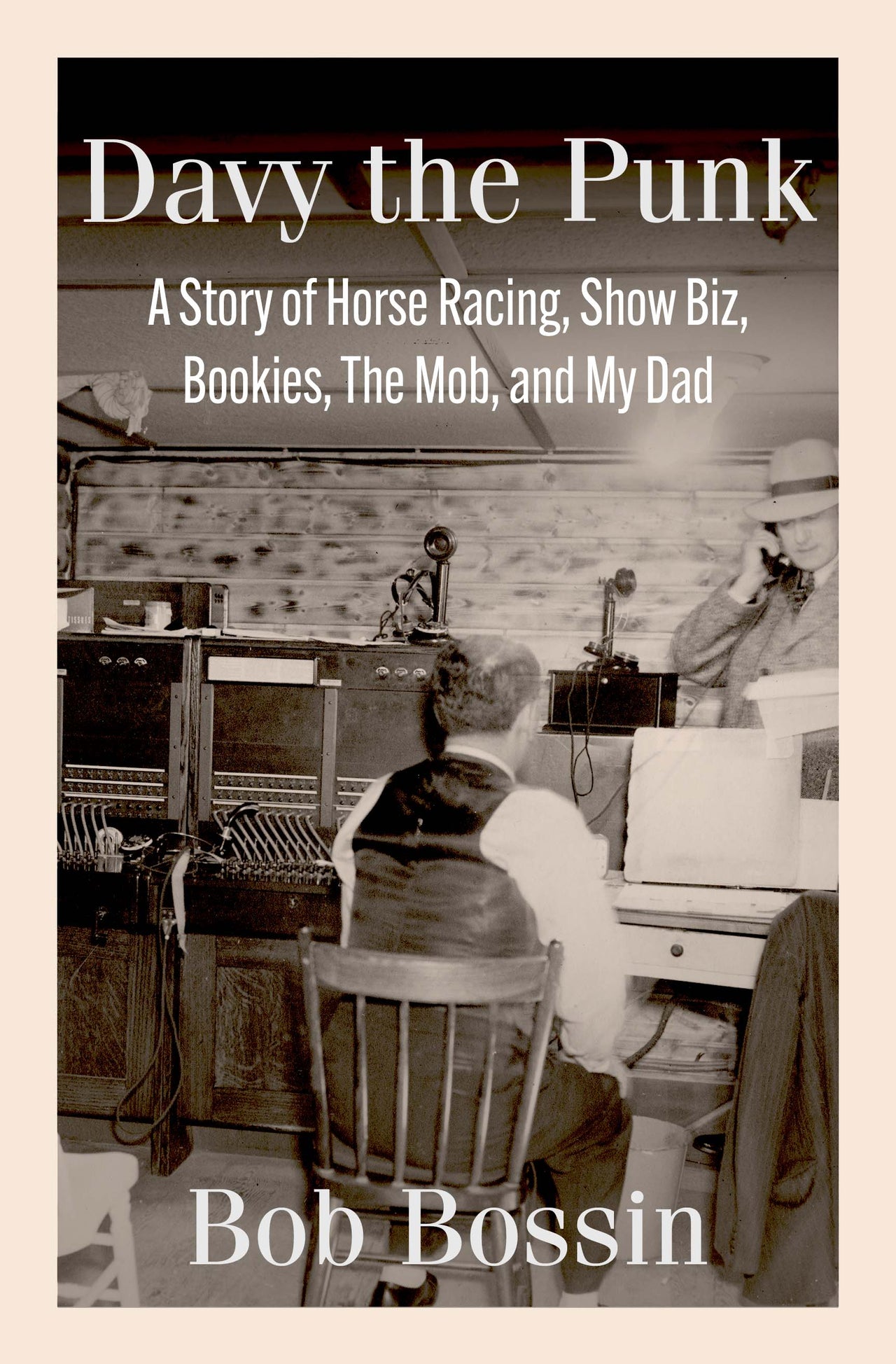
In Davy the Punk, Bob Bossin tells the story of his father’s life in the gambling underworld of the 1930s and ‘40s. This sometimes poignant, sometimes outrageous memoir of father and son is packed with streetwise stories and troubling revelations about Canada and the United States as they were in the first half of the twentieth century.
In the 1930s, Davy Bossin was known in the underworld as “Davy the Punk.” He was the “bookies’ bookie,” a layoff man who connected Toronto to the betting rackets in New York, Chicago, Detroit, and elsewhere. Davy’s colleagues and friends were some of the top outlaws in America. A consummate storyteller, Davy often regaled his pals with tales of horse-racing, the mob, and the equally gritty underside of show business. Eagerly taking it all in was his son Bobby, who would grow up to become indie-music pioneer Bob Bossin.
By turns funny, insightful, and moving, Davy the Punk is the story of horse racing, the Great Migration, antisemitism, baseball, gambling, show biz, and most of all, fathers and sons.

In the late summer of 1968, writers Terry Southern, William S. Burroughs, and Jean Genet were deployed by Esquire magazine to cover the Democratic Convention in Chicago. With photographer Michael Cooper and poet Allen Ginsberg inseparable parts of their coterie, the “fab 5” (as Michael Simmons dubbed them) were unflappable, capturing the calm and riding out the storm. These were turbulent times, as growing opposition to the Vietnam War inspired the Yippies to organize one of the biggest youth demonstrations of all time. Pot-smoking peaceniks descended upon Chicago from all over the country to protest the 1968 Democratic National Convention and the anticipated coronation of the Establishment candidate, Hubert Humphrey. Chicago was a Republican stronghold, and Mayor Richard J. Daley wanted to present a peaceful “law and order” city that wouldn’t tolerate any “outside agitators” or “unpatriotic” long-hairs.
No one could have foreseen the unprecedented mobilization of tens of thousands of young people from all over the country, and the lengths to which Mayor Daley went to shut them down. Michael Cooper and Terry Southern, no strangers to absurdity and highly attuned to the strengths and aspirations of youth culture, witnessed the deployment of the national guard, a belligerent police force “run amuck” and rioting, and the outrageous aggression unleashed on the protesters on the streets of Chicago—harkening to the hugely funded militarization of police forces today, and the continual need for their reform.
Chicago 1968: The Calm Before the Storm captures Michael Cooper’s celebration of his writer-friends and the protests in which they were playing a part—¬moments before the chaos and terror that became Chicago ’68. Accompanied by one of the great new journalism pieces by Southern, we have, with Cooper’s photos, an intimate and wry, world-weary account of a pivotal cultural moment whose city-sponsored violence has echoed throughout history and offers us a cautionary reminder for today. Chicago 1968 recalls the events of three fateful days in late August that must never be forgotten. With original research, curated ephemera and fresh commentary, Nile Southern and Adam Cooper highlight their fathers’ distillation of this pivotal moment in American history, exploring the fault lines between reportage, activism and poetry.
As the National Democratic Convention returns to Chicago this summer (2024), this book is more relevant than ever, particularly with the Democratic Party navigating its stance on Israel’s war on Gaza, and how forcefully the growingly disenchanted youth vote will express its demand for a peace candidate.
Why we love this book...
Chicago ‘68: The Calm Before the Storm documents the visual poetry, both in photos and written text, that is the Yippie Movement. We chose to publish this due to the timely nature of events mentioned in the book, as history often unfortunately repeats itself. Police brutality continues in prevalence, just as it did during the protests of 1968 at the Democratic Convention in Chicago. This piece of visual history includes never before seen photographs of the emotion, power, and intensity demonstrated during this time, and we are proud to publish this book at Genius Book Publishing, Inc.
“...captures the beauty, nuance, and complexity of the father-son relationship.” —Stefanie Wilder-Taylor, author of Sippy Cups Are Not for Chardonnay
When his mother was diagnosed with MS, Brian Frazer lost both his parents to the demands of the disease. His father, Sam, was his mother’s sole caretaker for forty years, unavailable to his children or his art. After his mother died, Brian had the opportunity to reconnect with Sam. But how could he reestablish the relationship? The answer was in a doodle.
One day—on a whim—he suggested his father draw a cartoon that Brian had written. The old spark returned to Sam’s eyes. With every cartoon, Sam came back to life, and so did Brian’s connection with his dad.
Brian Frazer is an author, stand-up comedian, and self-proclaimed neurotic. Cartoons With My Dad chronicles Brian’s quest to find his relationship with his father and, in the process, find himself.
Paul McCartney Was Alive... But Would Anyone Believe It?
In the fall of 1969, a rumor swept across college campuses and airwaves: Paul McCartney of the Beatles had died in a car crash, and the surviving band members had replaced him with a double. Students and disc jockeys poured over album covers and songs claiming to uncover hidden clues. Headlines, radio shows, and late-night debates turned the rumor into a cultural phenomenon.
Turn Me On, Dead Man tells the story of how the “Paul-Is-Dead” hoax spread and why so many people believed it. From a phone call to a Detroit radio station, to a satirical review in The Michigan Daily that became front-page news, the book traces the rumor’s rapid rise. With careful research and rare material from newspapers, radio transcripts, and firsthand accounts, Andru J. Reeve reconstructs how a six-week frenzy convinced thousands that the Beatles were sending secret messages about their fallen bandmate.
More than a simple catalog of supposed “clues,” this book explores the rumor’s social and cultural impact. It examines why people were ready to believe, how the media fueled the fire, and what this phenomenon reveals about fame, rumor, and the power of storytelling in popular culture.
Detailed, witty, and grounded in historical evidence, Turn Me On, Dead Man preserves one of the strangest and most fascinating chapters in the history of rock music and mass media.
Babe the bobcat lives in the Upper Newport Bay Nature Preserve. She recently received a tag and tracking collar so scientists could study her and her movements. Babe's Special Day is a delightfully told and illustrated story of one of the treasures of the Upper Newport Bay.
These information documents for each of the official Trade Mark of Quality releases includes the known details for each genuine TMQ title. This includes the TMQ catalogue number, artist, record title, track list, musicians, venue, recording date, master tape and record matrix info and the other particulars for each album.
IT’S TIME TO PUT YOUR CRIME SOLVING SKILLS TO WORK
Just between us, we know you like true crime investigations. You’ve seen every episode, heard every podcast, and now you can name the killer in the first five minutes of that cable show you’re watching… again. But how many times have you yelled at the screen, “YOU GOT IT ALL WRONG!” Well, Barney Doyle is here to tell you that they probably did.
Reckless Speculation about Murder takes on some of the most infamous unsolved cases in recent American history. From the murders of JonBenét Ramsey and Kathleen Peterson to the shootings of Tupac Shakur and Biggie Smalls, your host Barney Doyle will lead you through the evidence, give you all the facts (even the inconvenient ones), and let you decide for yourself who committed these infamous atrocities.
Disregard what you thought you knew about these crimes. Fill up your coffee cup (or wine glass), turn down Forensic Files, and take a fresh look at these notorious murders.
This is the Second Edition with an additional chapter on the Jeffery MacDonald case.
The Murder of Teresa Halbach
Before we go on, I should warn you that I am going to spend some portion of this book ridiculing criminal attorneys. I can’t help it. They are a ridiculous group of people. They are among the most educated and intelligent people we have in this country and have devoted their lives to civil service. They should be revered like doctors or astronauts, but instead they are derided like old-timey carnival barkers. The burden of proof is entirely on their shoulders, yet prosecutors are mocked as buffoons if they lose a case. Prosecutors who are too successful are portrayed as heartless henchmen for an oppressive government machine. Defense attorneys are villainized for protecting criminals even though we all understand it is their exact job to protect the rights of their clients, who are mostly criminals, and they would be disbarred for giving anything less than an honest effort.
But that’s the job they chose and most of the absurdities of the criminal justice system were created by their hands. They stacked one absurd brief or motion on top of another for two centuries until our courts were trapped in a slog of arcane case laws and nonsensical gibberish that only lawyers and sovereign citizens pretend to understand. I’ll give you a couple of observations from a decade I have spent as an occasional guest of the court: The judge is God in the courtroom, but God’s will can always be appealed to a council of higher deities; logic is suspended for the sake of ritual; and at least three jurors haven’t paid attention to a word the last witness just said.
Since I know that I am a weak man who will take numerous unprovoked shots at the attorneys involved in these cases, I do feel compelled to admit a couple of important things that I have noticed about attorneys. In their own little way, they always seem to tell the truth. I’ve seen doctors lie. I’ve seen clergy lie. I’ve seen my mother lie. I can’t recall seeing an attorney lie in court. Despite their reputation to the contrary, as a whole, attorneys seem to have a real commitment to their own narrow concept of truth. That’s not to say that they won’t mislead the shit out of you with an argument, because they will absolutely do that. But you can be sure that the argument is based on some truthful fact. Listening to attorneys is a lot like negotiating with the devil. They aren’t going to lie to you, but pay very close attention to the words they choose. Second, they tend to be much better mannered than you expect a professional arguer to be. I’ve heard horror stories about attorneys being jerks to witnesses on the stand but I’ve never actually seen it. I’ve always been treated with respect and decency when I testified. I’ve had my work criticized by defense attorneys while I was on the stand and that stung. But they were never jerks about it and the criticisms were always reasonably valid (probably why they stung).
So there you are, that’s a quick guide to attorneys from Barney Doyle. They virtually always tell the truth, even if only in a very literal and lawyerly sense of the word “truth,” and they aren’t nearly as bad as all of the jokes would have you believe.
I say all of that because we are going to talk about the tragic murder of Teresa Halbach and we can’t do that without reviewing the trial of Steven Avery. The defense attorneys who represented Avery, Dean Strang and Jerome Buting, became a pair of modern day Atticus Finches to a throng of worshipers on the internet after a flattering portrayal in the Netflix documentary Making A Murderer. The prosecutor, Ken Kratz, resigned in disgrace over allegations that he made unwanted sexual advances towards several victims in domestic violence cases that he was prosecuting.
In Avery’s trial, each side presented a theory on this case and the two theories were mutually exclusive. Lots of times in a murder trial the defense won’t present a theory, they will just poke holes in the prosecutor’s theory. Other times the defense will accept the bulk of the prosecutor’s theory without argument and try to insert doubt through insanity, self-defense, accident or some other gray area in the law. The Steven Avery trial was the rare case where the prosecution and the defense offered specific theories that directly contradicted each other. One of them, at a minimum, has to be wrong. What we think happened to Teresa Halbach depends largely on who we are going to believe, the modern day Misters Finch or an alleged sexual predator. I know whose side you want to take on this one. Hell, I know whose side I want to take on this one. But as I mentioned before, attorneys virtually always tell the truth in court. So let’s wade through all of this contradictory truth and see if we can’t figure out what actually happened.
Also, before we go any further, I want you to take a moment and consider your own interest in these cases. I love true crime stories. You love true crime stories. Lots of people love true crime stories. There is nothing wrong with loving true crime stories. The subject matter is macabre, but that doesn’t make it off limits for decent people like us to discuss. We don’t love murder and we certainly don’t want to celebrate murderers. If anything, our love of true crime is mostly borne of an obsession with finding the truth and holding murderers accountable. The crimes we are going to look at, like the murder of Teresa Halbach, were devastating events to a lot of innocent people who cared about the victims. And that is before you even account for the horrors that the poor victims themselves suffered. We recognize the tragedy, hate the suffering, and love the story still. We are searching for the truth among muddied details in most of these cases, but we are never confused about where our sympathies lie. The victim is the most important person in every one of these stories. Even though we enjoy studying these crimes, we still wish they had not happened in the first place.
And I know a lot of you developed your interest in these things in relation to some personal tragedy in your own life. Studying horrific crimes is, for some people, a coping mechanism for dealing with trauma. I’ve seen more death and violence in my life than I ever imagined I could handle. These murder stories should stir up a lot of terrible memories for me. But they don’t. They allow me to dissect the horrors of this world from a comfortable arm’s length away, secure in the knowledge that I can always just close the book or the laptop at any time. It’s a weird way of distracting yourself from the boogieman under your bed by reading about the boogieman three states over. It shouldn’t work, but it does.
That said, we all have those true crime cases that hit too close to home. If any of these cases are like that for you, or if, God forbid, you personally knew one of the victims, please just skip that chapter. You won’t miss anything important, I promise, and you’ll catch up on the next case.
Also, now is an appropriate time to offer my sincere thanks to Skip Topp and his friends over at stevenaverycase.org for compiling the trial transcripts and all of the supporting exhibits from the Steven Avery trial. Trial transcripts are public records but are usually prohibitively expensive, so I am very grateful that they acquired and shared them. The facts below come from those transcripts, several other motions filed by attorney Kathleen Zelner and, to a much lesser extent, the Making A Murderer documentary.
Teresa Halbach was a 25-year-old photographer living in semi-rural Wisconsin. She was relatively new to the business so she shared studio space with another photographer and supplemented her income by doing freelance photography for an Auto Trader magazine. If you aren’t familiar with Auto Trader, picture Craigslist car ads compiled in a free newspaper that was available in a filthy display box outside of every gas station. If you aren’t familiar with newspapers, imagine printing a collection of articles from the internet onto awkwardly large and absurdly thin paper that you could take with you to the bathroom. If you don’t remember articles, they were like memes but with 800 to 1,000 words and sometimes no picture.
On Halloween day of 2005, Teresa Halbach was taking photos of vehicles for three different customers in and around Manitowoc County, Wisconsin. One of those customers was a man named Steven Avery who lived in a trailer at the Avery Salvage Yard. Everybody agrees that Teresa visited the Avery Salvage Yard that day. And everybody agrees that Teresa’s burned remains were found in a burn pit behind Steven Avery’s home several days later. But what happened between those moments is fiercely debated.
The prosecution’s version of events:
Teresa Halbach had taken photos at the Avery Salvage Yard on several occasions before. She complained to a coworker about Steven Avery’s peculiar behavior. She said that Avery once met her at the door wearing nothing but a towel.
On October 31, 2005, Avery called Auto Trader magazine and specifically requested that Teresa come take photos. Avery gave the Avery Salvage Yard address, but gave the name B. Janda instead of his own. Avery’s sister’s name was Barb Janda and the vehicle that Teresa was supposed to photograph belonged to her. Avery had Teresa’s cell phone number and called her twice before she came out to the salvage yard. Both times he used *67 to block his name and number on her caller ID. She didn’t answer either call. He called again later in the day, presumably after her visit, but did not use *67 on the third call.
Bobby Dassey lived in a trailer at the Avery Salvage Yard with his mother (Barb Janda) and brothers. He saw Teresa taking photos of his mother’s van that afternoon, then saw Teresa walking toward Avery’s trailer. Bobby took a shower and left to go hunting. He saw Teresa’s green Toyota Rav4 parked out at the property but did not see Teresa anywhere when he left.
Multiple witnesses reported seeing a bonfire and/or a fire in a burn barrel at Steven Avery’s residence on the afternoon and/or evening of October 31. The statements conflict as to the exact time of the fires, but consensus seems to place them at around dusk into dark.
Friends and loved ones did not see or hear from Teresa after October 31, and her mother reported her as a missing person on November 3 in Calumet County Wisconsin, where Teresa lived. Police accounted for her whereabouts up to where she visited the Avery Salvage Yard, then the trail went cold.
A large search party of citizen volunteers, organized by Teresa’s ex-boyfriend and her roommate, combed the countryside looking for Teresa and her missing Toyota Rav4. Teresa’s second-cousin located the Rav4 semi-concealed among the junk vehicles in the Avery Salvage Yard. The car was locked and partially covered with debris.
Police were notified and responded immediately. The Manitowoc County Sheriff’s Office was on scene first, but the investigation was turned over to the Calumet County Sheriff’s Office because of a conflict of interest. Standby for details on the conflict of interest because it makes up the bulk of the defense’s theory.
The Rav4 was hauled off on a wrecker to the Wisconsin crime lab. Lab technicians found Avery’s blood on the back of the gear shift and on the passenger side of the center console. His DNA, from a non-blood source, was also found under the hood on the latching mechanism. A small amount of Teresa’s blood and hair was also found in the rear cargo area of the Rav4.
Through a series of searches over the course of several weeks, investigators found Teresa’s bone fragments in a burn pit outside of Steven Avery’s trailer and in a burn barrel outside of the Janda home. They also found charred remnants of Teresa’s camera and cell phone in a burn barrel outside of Steven Avery’s trailer. Inside the trailer, investigators found a key to Teresa’s Rav4 in Avery’s bedroom and a fired bullet with Teresa’s DNA on it in the garage. The key also had Avery’s DNA on it.
Investigators interviewed Avery’s nephew, Brendan Dassey, several times over the course of a few months. He initially denied knowledge of what happened to Teresa, but eventually confessed to helping Avery rape and kill Teresa then burn her corpse.
The defense’s version of events:
An adult female (not Teresa) was brutally raped on a beach in Manitowoc County on July 29, 1985. DNA eventually showed that the rape was almost certainly committed by a man named Gregory Allen. But a poor investigation and a mistaken eyewitness identification led to the wrongful conviction of Steven Avery.
Avery was freed in September of 2003 and rightfully sued the bejeezus out of the Manitowoc County Sheriff’s Office. Either by winning the lawsuit or by agreeing to an out-of-court settlement, Avery was going to receive a huge settlement from the Manitowoc County Sheriff’s Office after 20 years in prison for a rape he didn’t commit. Circumstances changed when Teresa Halbach went missing the same day she visited the Avery Salvage Yard.
Among the officers deposed in Avery’s lawsuit against Manitowoc County were Lieutenant James Lenk and Sergeant James Colborn. Even though the investigation was turned over to the Calumet County Sheriff’s Office, Lenk and Colborn each participated in searches in which crucial evidence was discovered.
As is custom, investigators kept a log of everybody who came in and out of the crime scene at the salvage yard. There was one day when Lenk signed out of the scene log, but there was no entry for him signing in.
The Rav4 was found parked with the battery disconnected. There was a car crusher at the salvage yard not far from where it was located. The car crusher did not belong to the Averys, but they were known to use it on occasion.
One day prior to the actual discovery of the Rav4, Sergeant Colborn ran a license plate check of the vehicle through his dispatch. The majority of license plate checks are conducted by radio, but Sergeant Colborn ran this particular license plate check by cell phone.
Steven Avery’s trailer was searched three separate times before the key was discovered in his bedroom. It was discovered by Lenk and Colborn, who were searching under the supervision of a Calumet County detective. Lenk spotted the key on some slippers beside Colborn, who theorized that the key had fallen out of a small bookshelf while he was moving it. The key was also by itself, with no accompanying house keys or office keys.
The bullet with Teresa’s DNA was not discovered until months after the first search, and was discovered by Lenk. The garage had been searched multiple times before that, including a search that yielded fired .22 cartridge cases (or shell casings, as the cool kids call them).
The lab technician who identified Teresa’s DNA on the bullet deviated from her usual protocol on the test. Whenever technicians test for DNA, they also run a simultaneous “control” test to show that there was no contamination. On that particular control test, the sample was contaminated with the technician’s DNA. That usually isn’t a big deal. They throw out the test and try again. But the DNA test on the bullet consumed the entire sample, so she was unable to run another test. In all probability, the test shouldn’t have been considered valid for court purposes.
There was already a vial of Steven Avery’s blood in a box of evidence at the Manitowoc County Clerk of Court’s office. The Manitowoc County Sheriff’s Office had keys to the Clerk’s office, and Lenk was aware that evidence in Steven Avery’s original rape case was held there. Lenk had previously ordered one of his deputies to send some evidence from that box to the crime lab for testing. The vial appeared to have been opened at some point.
The vial of Avery’s blood had an anticoagulant called EDTA in it that is used to preserve blood samples in liquid form. The FBI tested Avery’s blood from the SUV and determined that it did not have EDTA in it, which would seem to refute the notion that the blood in the SUV was planted by law enforcement. The FBI only tested three of the six samples from the SUV, however. And the defense introduced an expert who suggested that there were problems with the test that the FBI used.
Teresa’s bones were discovered in both the burn pit in Avery’s backyard and a burn barrel near the Janda residence. There was also a third site near the Avery property where burned bones were discovered, but the crime lab was unable to determine if they were also bones from Teresa. At a minimum, either Teresa was dismembered and burned at two sites, or her burned bones were moved at least once before they were discovered.
The Avery Salvage Yard also had a commercial incinerator on site. It was not used to dispose of Teresa’s body.
Before we continue, I want to tell you a little story. I am not particularly handy but I am very cheap. Consequently, I do a lot of projects around the house that should be hired out to the professionals. I built a laundry room one time that didn’t have a straight edge or 90-degree angle in it. It wasn’t obvious to the naked eye, so I didn’t really care. Until I tried to buy a door. Door manufacturers make a lot of different sizes, but they are virtually all perfect rectangles. My opening was not. I shimmed and jimmied it every which way I could, but you can only be so precise when you don’t have straight edge to orient off of. It’s in the wall now, but I don’t trust that door to hold out a stiff draft.
The prosecution and the defense both have timelines for when they say Teresa was at the Avery Salvage yard, but they are built on imprecise and contradictory witness recollections. I don’t have any more faith in their timelines than I do in my laundry room door.
So now that we’ve laid that groundwork, let’s do a little reckless speculation about what happened to Teresa Halbach.
I love the care and craft that went into Dean Strang and Jerome Buting’s defense. A man wrongfully convicted of a rape he didn’t commit is released from prison only to be framed for murder. Lieutenant Lenk is lurking in the shadows of every search with another piece of fraudulent evidence. His henchman, Sergeant Colborn, covers for every misdeed in a zeal to preserve the reputation of his beloved department. Scientists at the Wisconsin Department of Justice and the Federal Bureau of Investigation cast aside their sacred oaths to jump into the conspiracy. Maybe the police are protecting the real killers. Maybe the police are the real killers. I love everything about this story. As fiction, it’s a winner. As an actual explanation for what happened to Teresa Halbach, it just doesn’t work for me.
It sucks that the Manitowoc County Sheriff’s Office participated in the investigation. They wouldn’t have asked Calumet County to take over the investigation if they didn’t believe there was a conflict of interest. Ideally they shouldn’t have even participated in the search. But practically speaking, they had to. It was a ridiculously large crime scene. The Avery Salvage Yard is 5 acres with over 4,000 vehicles and a dozen buildings. The Calumet County Sheriff’s Office was a 30-officer department trying to run a massive investigation in somebody else’s county. You could search that salvage yard around the clock for a week with a hundred trained investigators and not cover everything. Conflict of interest or not, Manitowoc County was going to have to lend a hand in that search.
James Lenk and Andrew Colborn did not have any reason to frame Steven Avery. They weren’t being sued. They had nothing to do with the investigation that led to Avery’s wrongful conviction. Neither man even worked for the Manitowoc County Sheriff’s Office at that time. They were deposed in Avery’s lawsuit because a phone call from a neighboring agency about Avery was misdirected to Colborn while Colborn was working in the jail. He properly directed the caller to the Sheriff’s Office detectives and had no further involvement in the matter. Lenk was deposed because Colborn told Lenk about the phone call. Neither man was at the slightest risk of being held personally liable in a lawsuit from Avery.
You could argue that loyalty to the Manitowoc County Sheriff’s Office might motivate Lenk and Colborn to frame an innocent man. You could argue that, if you enjoy losing arguments. Police don’t give a shit about their departments. It’s just an employer. The job is dangerous. It doesn’t pay that well. And police jobs are a dime a dozen. No police officer in the world is going to commit a felony to protect the reputation of their department or save the department from a lawsuit. Certain unscrupulous police officers might be willing to commit a felony to protect their own reputation or save themselves from a lawsuit, but not the department. Especially in a sheriff’s office, where the top guy is some politician that half the department didn’t even vote for and who could be gone at the next election.
But since we are recklessly speculating here, let’s follow this thread a little ways. If Steven Avery didn’t kill Teresa Halbach then who did? She didn’t have a boyfriend that we know of. Her ex-boyfriend, Ryan Hillegas, was still in her life in some capacity and would make for an obvious suspect. For reasons that aren’t entirely clear to me in reviewing the trial transcripts, the investigating officers ruled Hillegas out as a suspect fairly early in the investigation. I found a lot written about him on the internet, but nothing from any source that I would consider credible.
Avery hired attorney Kathleen Zellner to represent him on his appeal, which took place after his Making A Murderer fame. She has been very bold in proclaiming Hillegas as the actual killer. I wish I could afford to hire this woman to write the forward for this book. She is a marvel. You and I do a decent job of recklessly speculating about murders; Zellner is a master at it. Where we are bound by logic and decency, Zellner transcends reason and scoffs at decorum. We trust experts who have studied science while she directs doctors who invent science to conform to her theories. We are skeptical of witness statements that can’t be corroborated. She tells you exactly who is lying, why they are lying, and why anything that contradicts her theory is also a lie. We restrict logical inferences to only those things which can be logically inferred, and then we dampen those inferences with an acknowledgment of their uncertainty. Zellner can draw you a straight line from Teresa Halbach’s murder to Ryan Hillegas’ guilt using any small witness statement or piece of evidence and her own unique brand of deductive reasoning.
At the risk of infuriating Avery’s supporters by shortchanging the “newly discovered evidence,” I am going to abridge Zellner’s theory for you here:
Ryan Hillegas was a jealous and abusive boyfriend. None of Teresa Halbach’s friends or family ever mentioned anything about Hillegas being abusive, but the guy she shared a photography studio with did. He told detectives that, years ago, Teresa mentioned having an abusive ex-boyfriend. Therefore, Hillegas is a murdering woman-beater.
Teresa Halbach had a secret life where she was taking nude photographs, sleeping with her roommate and sleeping with a married man. Hillegas killed her because he was jealous. (I couldn’t find the affidavits that Zellner used to support the claims about Halbach’s personal life. For what it’s worth, true or not, it was shitty the way she used those “facts” to degrade the victim. And if I had to bet based on the rest of her arguments, I’ll take “or not” over “true” in a landslide.)
Hillegas told investigators that damage to the brake light and bumper on Halbach’s car was months old. No insurance claim was ever filed, so obviously Hillegas was lying to cover up the fact that he is a murdering liar.
Hillegas was an unemployed nurse at the time of the murder. He had the time to commit the murder (unemployed) and the advanced medical training (nurse) that would be required to plant Steven Avery’s blood in Halbach’s car.
The door to Avery’s trailer was unlocked. We can be certain of this because Avery said so himself in an affidavit and had absolutely no reason to lie. Obviously, since the door was unlocked, Hillegas snuck into the house and used his advanced nursing training to sneak Avery’s blood from the bathroom sink to Halbach’s car to frame Avery.
There were no phone calls made from Hillegas’ phone during the time of the murder (as calculated by Zellner). This was because his hands were occupied strangling Halbach to death. There were also no phone calls made at various points over the following few days because his hands were occupied with burning Halbach’s body and framing Steven Avery.
Investigators took photographs of Hillegas’ hands during the initial investigation. Those photographs showed scratches on the back of his left hand. Other photographs taken of Halbach during her lifetime showed that she had fingernails. Forensic pathologist Larry Blum prepared an affidavit saying that he was certain, “to a reasonable degree of scientific certainty,” that the scratches were caused by fingernails. Furthermore, he believed that they were caused by Halbach’s fingernails while Hillegas was strangling her. He deduced all of that from photos of Hillegas’ hands and reenactments he conducted with female staff members in his office. Presumably, Zellner didn’t require the doctor to carry the reenactment all the way through cremation.
Another doctor, Lawrence Farwell, has invented a technique he named “brain fingerprinting.” He is a Harvard-educated neuroscientist whereas I am but a humble state-educated police officer, so I will defer to Dr. Farwell as to the matter of whether or not the brain has fingers. But through brain-fingerprinting, Dr. Farwell can measure scientifically whether or not a person has knowledge of something. He measured with 99.9 percent certainty that Steven Avery didn’t know how Teresa Halbach was killed. Other neuroscientists have pointed out that Dr. Farwell’s claims seem farfetched and that his research doesn’t really adhere to the standards of what we consider “science.” But they are probably just bitter that they didn’t discover all of those fingers on the brain before he did.
I can’t recommend reading Zellner’s motion for a retrial highly enough. She torched every single person involved with the case, including Dean Strang and Jerome Buting. My favorite passage is when she asserts matter-of-factly that Sergeant Colborn conducted a clandestine illegal search of the Avery salvage yard with Hillegas’ help.
“The headlights were from Sgt. Colborn's personal vehicle and he had a friend of Ms. Halbach with him to search the Avery property without a search warrant because he did not have probable cause to be on the Avery property at that point in time.”
She just flat out says that a sworn police officer committed multiple felonies as if she were pointing out that the sky was blue. Her proof? Colborn called in for a license plate check on Halbach’s vehicle and he used a cell phone instead of his radio. And she could hear a voice in the background say “it’s her.” Colborn obviously made the call while trespassing at the Avery Salvage yard and the voice in the background couldn’t have been anybody but the lying, murdering, evidence-planting Hillegas.
As you might have imagined, the judge was unpersuaded and denied Zellner’s motion for a new trial.
Perhaps by the sequel you and I will be audacious enough to propose Zellner’s type of fantastically imaginative speculation, but we aren’t there yet. For now, let’s bound our recklessness in at least the realm of plausibility.
I think that Steven Avery killed Teresa Halbach. His blood was in her vehicle. His DNA was on her hood latch. Her car key was found in Steven Avery’s bedroom with Steven Avery’s DNA on it. A bullet with Teresa’s DNA was found in his garage and it was fired from a .22 caliber rifle that was found hanging in Steven Avery’s bedroom. Her bones were found in a burn pit outside of his house. Her cell phone and camera were found in a burn barrel beside his house. Each and every piece of that evidence is pretty damning.
I know you have concerns about the integrity of some of that evidence. Rightfully so. The bullet wasn’t found on the first search and it probably should have been. The story of how the key was found is a bit perplexing. It’s really weird that her bones were found at multiple locations on the Avery property. I will grant you all of those things. But murder isn’t a perfectly logical act and you will drive yourself mad trying to understand the how and why of every little thing the killer did. The kind of person who would brutally murder an innocent person is the kind of person who would do a lot of other peculiar stuff as well. Moving bones? It obviously made sense to the killer at the time because bones were moved. Maybe somebody moved the bones in an attempt to frame Steven Avery for the murder. But that person would have had to stage all of the other evidence as well, and the logistics just don’t seem possible to me (unless the police killed her, which is absurd). The most logical explanation I see is that Steven Avery moved the bones for reasons that probably made sense to him at the time. Steven Avery’s blood was in the car because Steven Avery bled in the car. Steven Avery’s DNA was on the hood latch because Steven Avery touched the hood latch when he disconnected the battery. The key was eventually found in Steven Avery’s room because Steven Avery hid the key in his room. The bullet was found in the garage with Teresa’s DNA on it because that’s where the bullet was fired. I admit that it lacks the imagination and flair of Zellner’s and Strang’s theories, but it fits the facts a lot easier.
So if we accept that Steven Avery was the killer, then why did he do it? They weren’t romantically involved so it wasn’t a case of domestic violence. Teresa was early into her photography career while Avery was in line for a huge settlement from Manitowoc County, so robbery doesn’t make any sense. Neither of them was involved in a street gang nor were they distributing narcotics. There is no reason to suspect self-defense, murder-for-hire, silencing a witness or any of the other oddball murder motives that occur in rare instances. I’m going to step out on a pretty sturdy limb and guess that it was sexually motivated. You knew that already, didn’t you? One step ahead of me as usual. But just for the sake of being thorough, let’s analyze it a little bit.
Making A Murderer would have you believe that Steven Avery was wrongfully convicted of rape because he looked a lot like the actual rapist and the Manitowoc County Sheriff’s Office bungled the investigation. In truth, Steven Avery was wrongfully convicted of rape because he looked a lot like the actual rapist, the Manitowoc County Sheriff’s Office bungled the investigation and Steven Avery’s behavior made it really easy to believe that he would rape somebody.
According to a report by Kurt Chandler in Milwaukee Magazine, Avery was convicted of burglarizing a bar when he was 18 and burning a cat alive several months later. I haven’t seen the court records or police reports from either of those charges, but they fit into the general pattern of Avery’s life. In September of 1984, a neighbor reported that Avery had been harassing her for months. When she drove past his house on the road to her own home, Avery would run and stand on the side of the road naked or stand at the front of his car and masturbate in plain view.
In his report, the investigating detective noted, “He has field glasses on the house and he knows just when she will be driving past the residence. At this point he will then run out to the road and do his tricks.”
In January of 1985, Avery was arrested for running a woman’s vehicle off the road and pointing a rifle at her. In April of 1985 he was accused of repeatedly driving by another woman’s house and shouting obscenities. In May of 1985 an 11 year old girl in a neighboring community was kidnapped and raped. Avery was never charged with the crime, but officers noted that he fit the physical description of the suspect and was identified by a witness as fishing in the area at the time. In June of 1987, Avery’s wife accused him of sending threatening letters from prison. In September of 2004, one year after being released from prison, Avery’s girlfriend accused him of domestic assault.
It’s a tragedy that a rapist was left on the streets because of Manitowoc County’s shoddy investigation. Gregory Allen, the actual rapist, was free for another ten years and committed atrocities that we likely won’t ever even know about before he was eventually caught for another rape. It’s infuriating. But let’s be honest, there were going to be concrete and bars in Avery’s future eventually anyway.
If the earlier reports of Avery’s roadside self-gratification were true then it’s not a stretch to think that he later developed a fixation on Teresa. The 1984 police report accuses Avery of targeting a specific female with his roadside shenanigans, going so far as to watch her house with binoculars so that he wouldn’t miss her. I’ve never known prison to do a really good job of curing perverts of their impulses. Sometimes it does teach them to conceal those impulses better. A man waving his weiner at a woman from the side of the road could just be a few years in prison away from learning to cover himself with a towel when he attempts to shock his future victims.
You and I may disagree on this one because I seem to think it’s a bigger deal than everybody else does, but I believe it is very relevant that Avery made two phone calls to Teresa using the *67 feature before she arrived at his house and one call afterward without using it. What legitimate reason would he have for blocking his number? This was in the early 2000s. I’m suspicious that a man Steven Avery’s age even knew about *67. A middle-aged guy in Wisconsin in 2003 who dismantled junk vehicles for a living was not aware of *67 unless he was using it for nefarious reasons. I didn’t know about *67 until 2006, and that was only because I became a police officer and saw it used for nefarious reasons. I am also nearly two decades younger than Steven Avery.
The phone call afterwards without *67 shows he had a plan. When she was reported missing and they checked her phone records, he could point to that call as proof that he hadn’t made the two blocked calls earlier. Obviously that fell apart when they checked his phone records, but those things happen when simple people attempt complex crimes. I said he had a plan, but I never said it was a good one.
It is also relevant that this happened while Steven Avery’s live-in girlfriend was in jail. I won’t go so far as to say that it is necessarily evidence, but it is an interesting fact nonetheless. If Steven were truly innocent, how unfortunate for him that Teresa was murdered while his alibi wasn’t available. But if he’s guilty, of course he would plan it for a time when his girlfriend was away.
OK, I’m satisfied that Steven Avery probably killed Teresa Halbach and that it was a sexually motivated crime. Now let’s get a little reckless with the speculation. Let’s theorize how it happened.
The autopsy revealed two bullet defects in Teresa’s skull and the .22 caliber bullet fragment located in the garage with Teresa’s DNA on it was fired from a .22 rifle found in Steven Avery’s bedroom. It’s fair to say she was shot. But where did it happen and what led up to it?
Bobby Dassey testified that he last saw Teresa walking toward Steven Avery’s trailer. Assuming she made it inside, what happened next? None of Teresa’s blood was found in the trailer, so I think it’s fair to say that she was not shot in the trailer. A gunshot wound to the head is bloody, even with a smaller round like a .22 caliber. I just can’t envision a scenario where Steven Avery would be able to clean up all of that blood without leaving a trace. If she was on carpet when she was shot, the blood would have soaked into the carpet pad and the subfloor. Even if she were on linoleum or tile, the blood would have spread over such a large area that it would almost certainly have made it into cracks and crevices that Avery wouldn’t have been able to clean. And that isn’t even factoring in the spatter that would have hit the walls. It is really hard and requires time and effort to make an indoor bloody murder scene disappear, and Avery would have been in a big hurry.
The bullet with Teresa’s DNA was found in the garage so it makes sense that she was shot in there. In Zellner’s appeal she made a very big deal out of the fact that the bullet did not have any bone fragments embedded in it. For reasons that confound me even on multiple readings, Zellner was convinced the lack of bone material on the bullet somehow proved that Avery didn’t shoot Halbach. There seem to be two pretty obvious explanations. The first being that her expert might be full of crap. The second is that the bullet found in the garage might have passed through Teresa without striking a bone. A .22 is a small and fast-moving bullet, so I doubt the round found in the garage was one of the rounds that hit Teresa in the head. Forensic pathologists have explained to me in the past that .22 caliber bullets are notorious for ricocheting off bones around the inside of a person’s body without ever exiting. I have a tough time believing that a .22 caliber bullet that penetrated the skull in one spot would still have enough momentum to make it out the other side and onto the garage floor still intact. But there are a lot of places where a round could pass in and out of a human body without striking bone, and we have no idea how many times Teresa was actually shot.
So if she was shot in the garage, then that raises the question of why none of Teresa’s blood was found in there. If you were to get upset with old Barney Doyle for some undoubtedly legitimate reason and punch me in the nose, I’d bleed all over the bare concrete floor in my garage where I am typing this. So as not to upset my wife and risk another punch in the nose, I’d wipe that blood puddle up with a shop rag before it stained the floor. If you came back a month later and sprayed a crime scene product called Luminol on the floor, the spot where that puddle had been would light up, especially under an alternative light source. Then you wouldn’t have to hit me again, you could just point to the floor and remind me to watch my manners.
Crime scene technicians used Luminol in Steven Avery’s garage and saw a stain come out that was about the right size to be from a gunshot wound to the head.
So with the same scenario as above, what if old Barney Doyle didn’t feel comfortable leaving puddles of DNA everywhere and decided to clean up that blood puddle with bleach instead of just wiping it up with a shop rag? What happens if you come back a month later with a bottle of Luminol this time? The spot still lights up, but because of the bleach not the blood. Bleach kills everything in the blood that reacts with the Luminol, but the bleach itself causes a reaction.
The evidence technicians in Steven Avery’s garage used a presumptive blood test on the stain and determined that it was not blood.
So what if we discussed our problems like adults and you never punched old Barney Doyle in the first place? I’m clumsy and it is a garage, so I have at various times spilled brake fluid, antifreeze, medicated shampoo and Heinz 57 sauce on the floor. You bring the Luminol over and what happens then? First, I ask where you are getting all of this Luminol. After that, I have no idea. There are a lot of things that react with Luminol. Maybe the floor lights up, maybe it doesn’t.
So maybe the Luminol lit up in Steven Avery’s garage because he used bleach to clean up blood on the floor or maybe it picked up on something else. Either way, I don’t understand how he managed to shoot Teresa in the garage multiple times without making a giant bloody mess. It was a cluttered garage and clutter has a way of catching blood spatter. If she were standing when she was shot in the head, the blood spatter would have originated five-and-a-half feet off the ground and high-velocity spatter should have traveled all over the clutter. So I don’t think she was standing up when she was shot. And I’m not entirely convinced she was conscious at the time, if alive at all.
Back to Teresa in Steven Avery’s trailer. If she was shot in the garage, then what happened between the trailer and the garage? Obviously Avery could have been waiting with the rifle and walked her into the garage at gunpoint. That would explain why there was no sign of a big bloody struggle in the trailer. But we agreed earlier that this was a sexually motivated crime. What would he get out of it by walking her out to the garage and shooting her?
They found a set of shackles in Avery’s house when they searched it. They were kinky shackles and he claimed that he purchased them to spice things up with his girlfriend. I would have thought that sex with a portly middle-aged felon would have been all of the spice a woman could ask for, but I guess I’m a prude. At any rate, Avery could have met Teresa at the door with the rifle and ordered her into the shackles. Teresa’s DNA wasn’t found on the shackles, but maybe Avery was the type of gentleman to clean his sex toys between uses.
The theory that I keep coming back to, even if I can’t fully articulate why, is that Avery strangled her. I hate the theory because it would have been a painful and terrifying way for Teresa to die. I’d feel better knowing that Avery lured her out to the garage with some clever ruse and that she died instantly and painlessly from a gunshot to the head that she never saw coming. But I have this gut feeling that the sick son of a bitch strangled her to death. Let me outline it for you and see what you think.
During his interview with police, Steven Avery was adamant that Teresa never came in to his house. That is a bold claim to make if it wasn’t true. Police recognized the opportunity to catch him in a lie and tried to scare him off that story. There is so much trace evidence that could be left behind when a person is in a house. Police laid out how hairs, fibers, fingerprints and DNA evidence works and Avery had to have recognized what it would mean if they found anything linking Halbach to his trailer. It would have been so easy for Avery to just say that she stepped in the trailer for a minute to collect his money or leave a receipt. Then he would have had an excuse if they found any traces of her in the trailer. But he didn’t waiver. He insisted she was never in there. Maybe he was bluffing because he was that confident in how well he cleaned the place. But I think he was telling the truth. I don’t think Teresa was in there.
Avery said he followed Teresa out to her car to give her the money for the photo shoot. He described talking with her at the driver’s side door. This would have been in plain view of anybody who was passing by on the roadway or looking out the window of his sister’s house. It would have been too risky for him to walk out there holding a rifle. He could have knocked her unconscious by smashing her over the head with something, then thrown her in the back of her own car. But that would have also made a bloody mess. There was a small amount of Teresa’s blood and hair in the rear of her car, but not consistent with having her head split open from a crushing blow.
I think Avery strangled Teresa at the door of her car, either with his hands or with some sort of makeshift ligature. He could have done it quickly and would have been mostly concealed from view by the vehicle. When he was done, he could have thrown her into the rear of her car and moved the car into his garage. If she nicked her head on something during the struggle or while he was moving her, it could have opened up a minor cut that would have left a small amount of blood and hair in the back of the car.
Once in the garage, Steven Avery could have acted on his sexual intentions while Teresa was bound, unconscious or already dead. I don’t care to speculate on what Steven Avery did here. I’m going to think happy thoughts about what prison is like for murderers and skip to the end.
Like a million other guys in the midwest, Avery was a deer hunter. As such, he had undoubtedly used his garage to dress a dead deer before. From experience, he surely knew that he could make cleanup easier and prevent a bloody mess by strategically placing plastic or newspaper and putting Teresa in a convenient spot before shooting her. And if she was already dead from the initial strangulation (which is the theory I choose to believe because there is less torture and suffering involved), then the gunshots would have produced minimal blood loss anyway.
“Why would he shoot her if she was already dead?” you ask. I refer you back to my earlier analysis: Weird people do weird stuff sometimes and we won’t always know why. Or you can go with the alternate theory that she didn’t die until he shot her, but I’m writing this so I am going with the lesser of two horrors.
From that point, it’s pretty straightforward. Over the next two days he hid her vehicle in the salvage yard, hoping it wouldn’t be found before he had a chance to do something more permanent, and burned her body and all of the evidence in the burn pit and burn barrels around his house. He didn’t use the car crusher or the incinerator because he rarely used either of those things in the course of his job and didn’t want his brother and father asking questions like “What car are you crushing?” or “What the hell are you burning in that incinerator?” while he was at the center of a missing person investigation. Eventually the plot was discovered, and Dean Strang became an unlikely heartthrob through Netflix.
OK, OK, stop screaming at me. We’ll talk about Brendan Dassey. This was a terrible story to begin with, and it isn’t going to get any better if we bring Brendan Dassey into it. But since you insist, here it is.
Brendan Dassey confessed to assisting his uncle Steven Avery with the rape, murder and disposal of Teresa Halbach. He was convicted. That conviction was overturned. Then it was upheld. Then depending on the day of the week, he is either free pending an appeal or back in jail.
Dassey told a story that was, according to the prosecutor, so rich in detail that it could not possibly have been made up. Dassey only could have gotten those details from being involved. In the professional opinion of old Barney Doyle, the confession is absolutely made up and the details Brendan Dassey gave don’t match the crime scene at all. But what do I know? I wasn’t there for the investigation and, even if I was, we have already established that I am a moron. Maybe he did do it after all.
Brendan was 16 years old at the time of the murder and lived with his mother and brothers next door to Steven Avery. Like everybody else in his family, Brendan was interviewed by police several days after the murder. He gave a story that was complete and utter horseshit, which put him on the police radar. His initial story was that he didn’t see Teresa at the Avery Salvage Yard, but then he might have seen her, but then he definitely saw her leaving and driving away. Police rightfully suspected that Steven Avery had coached Brendan on what to tell them, and the details of his story crumbled under the slightest bit of scrutiny.
Several months later, police did a follow up interview with Brendan at his school. This time Brendan said that he saw Teresa’s body in the burn pit behind Steven Avery’s house on Halloween night while Avery was having a bonfire. He said that he was scared of Steven and didn’t want to get him in trouble, so he didn’t say anything.
The police came back and interviewed Brendan two more times. In those interviews, Brendan claimed that he actually first saw Teresa tied to Steven Avery’s bed. Avery told Brendan to rape Teresa, which he did, then Steven slit Teresa’s throat. They loaded her body into her car, for some unknown reason, and then burned her in the burn pit.
This was the story that got him convicted and I don’t understand how. I will grant the prosecutor that it was rich in detail, but the details seem like nonsense to me. If Steven Avery slit Teresa’s throat on his bed then there would have been blood all over that room. Blood would have absolutely soaked into the mattress. The prosecutor argued that Avery burned the sheets, and that was apparently good enough. Also, while Teresa’s car was supposedly in the garage, why in the hell would they put her body in it? It’s not like they drove her fifteen feet to the burn pit. And there was only a small amount of blood in the back of her car. If she had her throat slit there would have been a lot of blood leading all the way from the bedroom to the car, and there is no way Avery could have cleaned that up well enough to hide it from the crime scene technicians.
I was working on a cold case homicide a few years ago where two men were wrongly convicted in the 1990s. A key piece of evidence was the testimony of a supposed co-conspirator, who was mentally challenged. While I was reviewing the transcripts of his police interview, I was struck by how completely off the guy’s story was. He didn’t get a single detail right that the investigators didn’t tell him first. I met the investigators and knew them to be good men. I also knew that they firmly believed they had the right guys, right up until DNA proved otherwise. It’s a really bad feeling when you aren’t making progress in a murder case. It gets downright desperate if the case is high profile. Put enough pressure on an investigator and they will start to see things that aren’t there and find meaning in things where there is none. I know why they believed what that guy was telling them, but with the benefit of time and distance it was clearly garbage.
I say that because I got a very similar sense reading the transcripts of Brendan Dassey’s interviews. While I don’t believe Dassey was as slow as his defense attorneys alleged, he was a sixteen year old kid and not a particularly smart one. He was a textbook candidate for a false confession. As I read his confession, I was troubled by how much of his story was either wrong or common knowledge. It seemed like the only time he got things “right” was when he was agreeing with statements that the investigators made.
Police were right to make him a suspect because he was clearly lying on the initial interview. I actually believed most of the second interview, when he described seeing the body in the fire. It was logical, it didn’t contradict the known facts in any meaningful way, and it seemed like he was providing the information not agreeing to it. But I don’t believe the rest of his confession and I certainly don’t think it was believable enough to sustain a criminal conviction.
Plus, his confession contradicts our strangling theory and we have entirely too much invested in that to give up now.
That’s not a bad start huh? We believe Steven Avery killed Teresa Halbach, acting alone. We have concerns about the integrity of some of the evidence, but ultimately not enough to come to a different conclusion. We think he attacked her in the driveway near her car and shot her in the garage, without ever taking her into his home. I think she was strangled and shot, but you aren’t certain if you agree with that or not. We think Brendan Dassey learned about the crime after the fact, possibly seeing Teresa’s body in Avery’s burn pit, but that he loved and/or feared his uncle too much to say anything initially. We would hire Dean Strang and Jerome Buting if we were ever accused of murder. And this book would be a thousand times better if it were written by Kathleen Zellner.
I hope all of our cases go this smoothly.
Stacey Macbeth knows the streets of Chicago better than anyone, but his beat is like no other—Cabrini Green, one of the most infamous housing projects in America. As a tactical officer, Macbeth works to keep peace in a place ruled by gang violence and a constant undercurrent of fear. But when a major drug shipment disappears, the delicate balance of power shatters. Determined to recover their missing stash, a ruthless gang begins a trail of violence that threatens to spill beyond the neighborhood, endangering the entire city.
Caught in a high-stakes race against time, Macbeth and his team must navigate the treacherous web of Cabrini’s factions to stop the gang before it’s too late. In a world where every decision can mean life or death, Macbeth’s resolve is tested as the streets he’s sworn to protect erupt in chaos.
Drawing on firsthand experience from his years as a Chicago police officer, Dave Case paints a vivid, unflinching portrait of life on the front lines. Gritty, intense, and deeply authentic, Out of Cabrini captures the human drama and explosive action of a city in crisis. With lives hanging in the balance, the story builds to a gripping, unforgettable climax.
<html xml:lang="en" epub:prefix="z3998: http://www.daisy.org/z3998/2012/vocab/structure/" xmlns:epub="http://www.idpf.org/2007/ops" xmlns="http://www.w3.org/1999/xhtml" lang="en">
<head>
<title>Chapter 7: The Preliminary Hearing</title>
<link rel="stylesheet" type="text/css" href="css/style.css"/>
<link rel="stylesheet" type="text/css" href="css/media.css"/>
</head>
<body>
<div id="chapter-7" class="element element-bodymatter element-container-single element-type-chapter element-with-heading" role="doc-chapter" epub:type="chapter">
<div class="heading heading-container-single heading-size-full heading-format-full heading-alignment-flexible heading-without-image">
<div class="heading-contents">
<div class="title-subtitle-block title-block-with-element-number">
<div class="element-number-block">
<div class="element-number case-mixed"><span class="element-number-term">Chapter</span> <span class="element-number-number">7</span></div>
</div>
<div class="title-block">
<h1 class="element-title case-mixed">The Preliminary Hearing</h1>
</div>
<h2 class="element-subtitle case-mixed">0930 Hours—Monday</h2>
</div>
</div>
</div>
<div class="text" id="chapter-7-text">
<p class="first first-in-chapter first-full-width first-with-first-letter-i"><span class="first-letter first-letter-i first-letter-without-punctuation">I</span>t was a Monday morning in Branch 42, a satellite felony courtroom at Belmont and Western, part of the Circuit Court of Cook County. It was crowded, but it always was, particularly on a Monday. It stank, too. The heater was going full bore. The place smelled of stale sweat and… funk, and this in the dead of winter, too.</p>
<p class="subsq">Judge Margarette Coleman-Brown slid her reading glasses to the end of her nose. She wanted to take a deep breath, but she didn’t dare. Not when it reeked like it did. Instead, she sat back in her chair. How she hated the beginning of the week.</p>
<p class="subsq">She had recognized that her sour moods were no longer contained to just Monday mornings. Her disposition began to darken as the afternoon waned on Sunday. It wasn’t fair to her family; they were suffering from her crabbiness. She had begun to doubt whether a felony trial room was worth the price, but doing bond hearings and prelims was a necessary step to get there. Yeah, life would be good then. There weren’t many black female trial jurists. She didn’t see how they could pass her again. The next seat had to be hers. It had better come soon, though.</p>
<p class="subsq">She sighed and wondered if a fan might not help with the odor. But stirred-up funk was still just that. It occurred to her that the bench sat up high in the room. Was funk hot air? Or did the hot air rise and bring the odor with it? She could get lower in the room, but then she’d be closer to the source. This wasn’t getting her call handled. She gave a nod to her clerk. “Let’s get the in-custodies out of the way next.”</p>
<p class="subsq">The clerk flipped the last in-custody file open. “Mister Sheriff, bring out Alonzo Huggins.” The holding cell door clanged open and two deputies escorted a black man out. He was wearing a Department of Correction tan jumpsuit with the sleeves ripped off to expose arms that were thick with prison muscle. His hair was pulled tight in cornrows. She hated that style. It looked stupid and was associated too strongly with the whole “thug life” motif. If that wasn’t enough, the man wore on his face an expression of utter contempt. She couldn’t tell if it was meant for her personally or just for the whole legal system in general.</p>
<p class="subsq">“Are you Alonzo Huggins?” she asked, as the man was brought in front of her. Jailhouse tattoos ran up and down his arms. He made her uncomfortable. And that was hard to do. “You will either say yes or no.”</p>
<p class="subsq">“Yeah.” Huggins flexed his hands. The sheriff’s deputies must’ve felt the same way about him. There were two, where one usually sufficed.</p>
<p class="subsq">“Do you live at 1150 North Sedgwick, apartment 1301?” This day couldn’t be over quick enough for her. She had to admit, though, she was glad this asshole wasn’t going anywhere. He looked like a real piece of work.</p>
<p class="subsq">“Yeah.”</p>
<p class="subsq">“Do you have an attorney, Mr. Huggins?”</p>
<p class="subsq">“Yeah.”</p>
<p class="subsq">“Who’s your attorney?” She had to admit to being a little surprised. What self-respecting member of the bar would want this guy as a client? Then again, were there any self-respecting attorneys to begin with?</p>
<p class="subsq">“Mr. Sherman Gold.”</p>
<p class="subsq">She raised an eyebrow. Ah, that’s who. Gold was in it for the money. No. Not just the money. He liked the glory, too. The action too, or, as she was sure he would say, the challenge. Huggins must have quite a bit to have Gold for his counsel. “Is Mr. Gold going to be here today?”</p>
<p class="subsq">“He outta town.”</p>
<p class="subsq">“Public Defender appointed for the purpose of the preliminary hearing,” she said to the court reporter. But she had briefly entertained the thought of giving Huggins a date. She’d just as soon not see him any more today. It was bad enough, as it was.</p>
<p class="subsq">“That’s bullsh… I want my lawyer!” Huggins raised his voice. He turned to the Public Defender’s bench. Steven Reifman, the courtroom’s PD, sat at the table. He was a skinny, nearly-bald white man in a brown, wrinkled suit two sizes too big for him. He looked like what she expected Bob Cratchet to look like. Overworked and underpaid. But, he was still a good, competent attorney.</p>
<p class="subsq">“Mr. Huggins, you’re not getting a continuance. Public Defender appointed. Take him in the back, Mr. Sheriff.”</p>
<p class="subsq">She sighed, feeling worn out. Maybe Traffic Court would be a better alternative.</p>
<div class="ornamental-break">
<div class="ornamental-break-block ornamental-break-aspect-wide">
<div class="ornamental-break-size-container ornamental-break-width-563">
<img alt="" class="ornamental-break-image" src="images/break-rule-gradient-screen.png" role="presentation"/>
</div>
</div>
<p class="ornamental-break-as-text">* * *</p>
</div>
<p class="first first-in-section first-full-width"><span class="first-phrase">Steven Reifman took</span> his stack of court files from the clerk and sat down at the Public Defender’s table. There were a lot of cases, as usual. He was handling the call without a partner, as usual. At least his day wasn’t as bad as it seemed the judge was having. Then again, most of her Mondays were crappy.</p>
<p class="subsq">He quickly looked through the folders. Since he’d worked in the office for twelve years, he’d come to know what to look for. This group of defendants was typical, except for Alonzo Huggins. Maybe it was going to be an interesting call, after all. He put the Huggins file on the top and stood.</p>
<p class="subsq">He walked behind the bench to the detention area. The sheriff just nodded at him as he passed. As he got close to the holding cell, Huggins stood. He’d been sitting on the metal bench: big, mean-looking, muscular, with a face that would freeze the heart of the bravest rabbi, particularly his eyes. Alonzo Huggins had absolutely frightening eyes. Like death whacked-out on crack.</p>
<p class="subsq">“Mr. Huggins?”</p>
<p class="subsq">“Yeah.”</p>
<p class="subsq">“I’m the PD appointed to represent you today. My name is Steven Reifman. I’m going to be your attorney.” He opened the file but couldn’t bring himself to look into those eyes staring at him through the lock-up bars. He waited for some kind of indication that Huggins had heard him. There was none. So he had to look up. Shit. “I said I’m representing you.”</p>
<p class="subsq">“What charges?”</p>
<p class="subsq">“Two counts Unlawful Use of a Weapon.”</p>
<p class="subsq">“What ‘bout my car?”</p>
<p class="subsq">“Well, let’s see.” Reifman scanned the case report. “It seems, Mr. Huggins, that your car was towed and impounded. It’s the law now that if you get caught with a gun, they can confiscate your vehicle.”</p>
<p class="subsq">Reifman compared the case and arrest reports for discrepancies. None. Huggins had been caught the day after release from prison with not one, but two, handguns. Reifman became aware of Huggins standing within feet of him, staring. He felt the skin on his forehead start to burn. He knew Huggins could reach through the bars and snap his neck.</p>
<p class="subsq">“Who tricked on me?”</p>
<p class="subsq">“Excuse me?” Reifman took a step back.</p>
<p class="subsq">“Who gave me up?”</p>
<p class="subsq">“I can’t tell from these reports.” Reifman looked up, but stared at the bridge of Huggins’ nose to avoid eye contact.</p>
<p class="subsq">“Give me some paper and something to write with. I got to get a message to my boys.”</p>
<p class="subsq">“Mr. Huggins, really.” Reifman grew brave. He lifted the files in front of his chest, as if they would protect him from the cold chill that gripped his heart. “I can’t give you anything to write with while you’re in the bullpen and, even if I did, I would have to read it first. If it contained any criminal content, I’d have to disclose that to the State’s Attorney. I’ll not be a party to a criminal conspiracy.”</p>
<p class="subsq">The clank of the lock-up door echoed throughout the holding area. Reifman took another step back and looked over his shoulder. The man entering the detention area was white, in his middle to late forties, and almost glowed with a golden hue. No salon tan. He had long salt-and-pepper hair pulled back in a ponytail and was dressed in a tailored Italian suit. Reifman stole a glance at Huggins. The monster was smiling; one gold tooth showed.</p>
<p class="subsq">“Good morning, Lonnie,” the man said, approaching. “I’m Sherman Gold, Mr. Huggins’ private counsel. Nice to meet you.” He held out his well-tanned hand, decked out in gold and diamond rings.</p>
<p class="subsq">Reifman was surprised. But recovered well enough to hand Gold the Huggins’ court file, instead of his hand. Better to be done with this one, anyway. A little too interesting, thank you very much.</p>
<div class="ornamental-break">
<div class="ornamental-break-block ornamental-break-aspect-wide">
<div class="ornamental-break-size-container ornamental-break-width-563">
<img alt="" class="ornamental-break-image" src="images/break-rule-gradient-screen.png" role="presentation"/>
</div>
</div>
<p class="ornamental-break-as-text">* * *</p>
</div>
<p class="first first-in-section first-full-width"><span class="first-phrase">Sherman Gold opened</span> the file and read. Finished, he turned to make sure no one was within earshot.</p>
<p class="subsq">“Not good, Lonnie,” he whispered. “Out Friday, pinched Saturday.”</p>
<p class="subsq">“I got to get my car back.”</p>
<p class="subsq">“We’re going to have to beat the case first. Might. Might get it back.” Even Gold felt uncomfortable giving Lonnie Huggins bad news. “There’s a different standard at the impound hearing. It’s only a preponderance of the evidence, not beyond a doubt anymore. On the face of it, I’d say that you’re screwed.”</p>
<p class="subsq">“Man, fuck all that. I got to get my motherfuckin’ car!”</p>
<p class="subsq">Gold fancied he could feel the heat from Huggins. He’d caught a last-minute flight from his Palm Springs home, cutting short his winter getaway, just to represent this client. He was well aware of the compensation he had received from representing the Mickey Cobras, but the money carried risk. Taking it was dancing with the devil; the fire was always there, so you could get burned by the slightest misstep.</p>
<p class="subsq">“What happens if we lose the case?” Huggins asked.</p>
<p class="subsq">“Well, you’ll go to prison on the violation, and they’ll try you for the gun case.” He looked up at his client, definitely the worst of the worst.</p>
<p class="subsq">“No, what be happenin’ to my car?”</p>
<p class="subsq">“Sold at an auction, more than likely.” Gold watched as Huggins grabbed the bars. The muscles in his arms bunched and swelled, but the bars held.</p>
<p class="subsq">“You got to tell my boys something for me,” Huggins said. “We got to be getting’ that car back. Shit still be in the motherfucker. Tell ‘em I be calling Boo’s.”</p>
<p class="subsq">Gold nodded and turned to walk back out to the courtroom. “I’ll tell them,” he said. “I just don’t see them being able to do anything about it. Not right now.”</p>
<p class="subsq">“Hold the fuck up,” said Huggins. “Who gave me up?”</p>
<p class="subsq">“Says here,” Gold said as he read from the case report, “that a concerned but unknown citizen flagged down the officers, after seeing you get into your car with the gun sticking out of your pants.”</p>
<p class="subsq">Huggins smirked, shaking his head. “Now, ain’t that some motherfuckin’ bullshit.”</p>
<div class="ornamental-break">
<div class="ornamental-break-block ornamental-break-aspect-wide">
<div class="ornamental-break-size-container ornamental-break-width-563">
<img alt="" class="ornamental-break-image" src="images/break-rule-gradient-screen.png" role="presentation"/>
</div>
</div>
<p class="ornamental-break-as-text">* * *</p>
</div>
<p class="first first-in-section first-full-width"><span class="first-phrase">The hearing took</span> place ten minutes later. There was a finding of Probable Cause and a filing of the Violation of Parole. Gold wasn’t surprised in the least. He’d better plan for a jury. His client would be doomed at a bench trial.</p>
<p class="subsq">He put on his cashmere coat, draped a scarf over his shoulders, packed up his briefcase, and picked up his wool cap off the bench. As he walked out through the courtroom, he nodded at the woman with the swollen face and yellow hair. He remembered her from Huggins’ last court case; she must be his girlfriend. The title apparently carried some penalties. Gold had a hard time looking at her left eye, which was swollen shut.</p>
<p class="subsq">There were two young teenagers with her. They must be the young men Huggins spoke of. Gold couldn’t help but wonder what kind of criminal backgrounds they must possess. Job security, no doubt.</p>
<p class="subsq">The entourage followed him from the courtroom to a secluded corner. The young men stepped in front of the woman. They didn’t identify themselves, nor were they asked to. The young man on the left crossed his arms and stared at him. The one on the right chewed at his thumbnail and looked at Gold with the eyes of a tired, old man.</p>
<p class="subsq">“Boo?” asked Gold. The man on the right nodded, still chewing on his nail.</p>
<p class="subsq">“Mr. Huggins asked me to deliver a message to you.” Gold thought for a second. How could he say this without saying it? He was a lawyer; it should be easy. Yet, it had to be within their ability to understand. It’d have to be practically spelled out and that, of course, was a good way to get into trouble. “He wanted me to tell you that he’s concerned about some… property he left in his car. He’s hoping that you’ll be able to get it back for him. He’ll call you at Boo’s apartment.”</p>
<p class="subsq">Boo stopped gnawing his fingernail long enough to shoot a glance at the other man. He nodded back. Boo dropped his hand. As he spoke, he looked away, talking into the corner of the lobby. “So, Lonnie only be charged with them guns, not no drugs, right?”</p>
<p class="subsq">Gold nodded his head. You just couldn’t be subtle these days. The sun of Palm Springs seemed like an eternity ago. He looked out the window and watched the snow fall. Traffic was going to be terrible on his way back to his office, and his calendar was empty for the next two weeks. Wonderful.</p>
<div class="ornamental-break">
<div class="ornamental-break-block ornamental-break-aspect-wide">
<div class="ornamental-break-size-container ornamental-break-width-563">
<img alt="" class="ornamental-break-image" src="images/break-rule-gradient-screen.png" role="presentation"/>
</div>
</div>
<p class="ornamental-break-as-text">* * *</p>
</div>
<p class="first first-in-section first-full-width"><span class="first-phrase">Latricia Gibbons’</span> swollen mouth twisted into a grin after Boo and Dease had walked by. A trickle of blood ran into her mouth from her split lip. The attorney began to bundle up. He told her that he was doing everything he could for Lonnie. Things was looking up. Shit, things could still be worse; he could get Lonnie out.</p>
</div>
</div>
</body>
</html>
Reverberations: 21 Classic 1950s Rock 'N' Roll Songs That Still Reverberate is a journey through the golden age of rock and roll. This book dives into the stories behind twenty-one iconic songs from the 1950s that have left a lasting impact on music and culture.
From the rebellious energy of "Hound Dog" to the infectious rhythm of "Rock Around the Clock," these tracks defined a generation and continue to inspire artists today. You'll discover how "Tutti Frutti" brought Little Richard's flamboyant style to the forefront and how "Johnny B. Goode" became a rock and roll anthem thanks to Chuck Berry's groundbreaking guitar work.
The Beatles, in their early days, played almost all these songs, showcasing their timeless appeal and influence. Ted Clark's meticulous research and insight offers a fresh perspective on these classics, revealing their origins, the numerous subsequent artists who covered these songs and/or included them on their concert set lists, the movie soundtracks they have appeared on, and why they still resonate with listeners around the world.
The book explores in detail the tremendous impact that songs like “Rock Around the Clock,” “Be-Bop-A-Lula,” “That’ll Be the Day,” and “Summertime Blues” had in the UK. And Clark explains why the artists who sang these songs—Bill Haley, Gene Vincent, Buddy Holly and The Crickets, and Eddie Cochran respectively—are more revered across the pond than they are in the U.S.
Whether you're a lifelong fan of 1950s rock and roll or new to the genre, this book provides a rich and engaging look at the music that started it all. With each chapter, you'll gain a deeper appreciation for the songs that shaped the course of popular music and continue to reverberate through the decades.