

"Mysteries in Music: Case Closed" is a book that uncovers the hidden, strange, and fascinating stories in the history of rock and roll. Jim Berkenstadt, known as The Rock And Roll Detective®, has spent years digging into these mysteries.
You'll travel back to the 1950s to find out who really discovered Elvis Presley. In the 1960s, a famous folk musician tried to create a supergroup with members from The Beatles and The Rolling Stones—what happened? Learn how some big-name artists used fake names to hide who they were. Explore a mysterious CIA situation in Jamaica in 1976, involving an election and the reggae legend Bob Marley. Did The Beach Boys really steal a song and its copyright from the infamous cult leader Charles Manson, keeping all the money? And dive into the secrets behind Nirvana's "Nevermind" album, which many consider the most influential rock album of the 1990s.
These mysteries have fascinated rock and roll fans for a long time because no one has asked the right questions or looked deeply into the evidence—until now. After many years, the untold stories of pop and rock music history are finally uncovered, revealing the truth in "Mysteries in Music: Case Closed."
See the review of Mysteries in the Music on CultureSonar.
Go on call with a homicide detective. Work through thirteen real homicide cases, interviewing witnesses, identifying evidence, and using current technology to identify suspects and ultimately solve a murder. Each case focuses on aspects of the criminal justice system ranging from writing search warrants, to interpreting autopsy reports, to preparing for a complex criminal trial. Experience the stories of the victims and their families as they pursue justice. Each case is broken down in detail, from the detective that actually worked the investigation. You learn the facts of the case as the detective learned the facts of the case. You are on the inside of the homicide investigation, following the facts and evidence to a logical conclusion. No homicide case is cut and dry, these cases are not always what they seem, and there is always a surprise.
On Call: Inside Homicide Investigations is a manual for Homicide Detectives. There is guidance on creating and presenting photo lineups, direction on using the proper verbiage regarding firearms terminology, and advice on dealing with legal challenges like dying declarations, hearsay, and justification of the use of deadly force. Whether you’re a true crime enthusiast, a writer, or an aspiring homicide detective, each case study offers lessons learned and real-world skills that will prepare you to be an experienced and well-versed homicide investigator.
5.0from 2 readers
CHAPTER 1 – THE ONE-ARMED MAN
On Memorial Day weekend in 2012, I was one of three detectives who were on call for all of Mesa, Arizona. I wasn’t in the Homicide Unit; I was in the Robbery Unit. Early in the morning, I was called out to assist the Gang Unit with a shooting that had occurred at a house party. Gang detectives handled the major parts of the investigation, but they needed help with interviewing dozens of witnesses and party attendees. I completed my assigned tasks in the late afternoon and went home to have dinner with my friends. Just as I finished cooking, I received a call on the dreaded department cell phone.
The on-call sergeant told me a male had been stabbed and pushed off the top of a parking garage in downtown Mesa. There were several witnesses, and patrol officers were actively looking for a possible suspect. The victim also told a first responding officer that he knew the suspect; he said his name was Deshawn. I was told the victim was in critical condition and undergoing surgery at a local hospital. I was also informed that I would be the case agent.
To understand criminal investigations, you should know the jargon that is the titles assigned to various functions done by detectives. Case agent is the title given to the lead detective in the case. In the Mesa Police Department, a case agent is always a detective, not a supervisor (such as a sergeant or lieutenant). The supervisors make sure the case agent gets the resources he or she needs and updates executive staff members (assistant chiefs and the chief of police) on the case status. In the Mesa Police Department, supervisors for a specific unit did not have to have experience in that unit’s specialty. In most cases, supervisors did not have any expertise in the units they supervised, so they really relied heavily on the knowledge of their detectives. Supervisors were also responsible for administrative duties, including approving overtime and the verbiage used in charging documents. Supervisors acted as a safeguard to make sure detectives operated within department policies, state laws, and county attorney protocols. As a case agent, your main focus is identifying the person(s) who committed a crime and developing probable cause to support an arrest and conviction. I want to reiterate the word “conviction.” Patrol officers are trained to develop probable cause for an arrest; a professional detective develops probable cause to make an arrest and secure a conviction in court. A professional detective digs deeper into cases and explores every aspect of the case than the average patrol officer. The case agent is responsible for ensuring all the facts in the investigation are accurately presented to the county attorney, who formally charges a potential suspect. The case agent’s role is very demanding as it involves understanding what all the other detectives and units assisting in the case are doing or have done. This can be difficult as most police officers have type-A personalities and will almost always go above and beyond their normal duties.
When I arrived at the crime scene, I was rushed by a flurry of officers and detectives. In the forty-five minutes it took to get from my home to the crime scene, officers and detectives who were on scene had identified a potential suspect and were actively looking for the person. This is when it becomes difficult as a case agent since you have to control everyone else’s overwhelming desire to put handcuffs on a suspect and then hand the individual to you to figure out the probable cause. A professional detective has to be methodical and logical when handling a complex investigation. You also have to be careful not to be dismissive of an officer’s enthusiasm because as a detective you need all the information you can get, in this case and any future cases. Consequently, I listened to everyone shouting out why Deshawn was the suspect and all the places he frequented, his criminal history, and how he matched the physical description given by the victim.
Normal protocol for investigations where detectives are called to the scene hours after the incident occurred calls for the detectives and supervisors to be given a briefing by first responders. This gets all the parties involved in the investigation on the same page so that everyone has the same information.
Over the course of my career, I’ve learned that briefings can be biased in nature. As a detective, you have to take in the information, but without evidence or witness statements to support that information, you cannot take it as a fact. It’s not that you don’t trust your fellow officers, but we’re all subject to confirmation bias. Confirmation bias is when we think we are right about something and then form our explanations around our presumptions to support what we think. This happens all the time in law enforcement and in society.
In the incident briefing, I learned that the Mesa Police received a 911 call stating that a man was yelling for help as he was hanging over the side of a two-story parking garage. Witnesses were walking back to their vehicles after attending a Memorial Day event. As the man was hanging from the side of the parking garage, a one-armed man was hitting or stabbing the victim’s hands in an attempt to make him let go. The victim eventually let go and fell to the ground, and his head struck a concrete curb. The bystanders rushed to the victim’s aid and noticed he was bleeding not just from the head but also from his chest. A SWAT officer was in the area doing directed patrol for the special event; he heard the radio traffic about the injured man and quickly responded to the scene. He was the first officer on scene. Being a SWAT officer, he had been trained in attending to traumatic situations, and he began assessing the victim. The SWAT officer noticed the victim had been stabbed several times in the chest and had stabbing-type wounds on his forearms and hands. The SWAT officer was present in the briefing and told us the victim was conscious when he attended to him. The victim was able to give his name and describe the man who stabbed him as Deshawn, a homeless male who was missing his lower right arm. The victim told the SWAT officer Deshawn had been arrested many times by the Mesa Police and they should know who he is.
A patrol sergeant interjected that the victim was in critical condition and was immediately rushed to surgery when he arrived at the hospital. The extent of his injuries was not known, but hospital staff stated the victim had numerous stab wounds to the upper torso and was bleeding internally.
A fellow detective chimed in that he was in the area when the call was initiated, and he arrived on scene with most of the patrol officers. He identified two witnesses who told him they heard the victim yelling for help and saw him hanging from the side of the garage. As the victim was yelling for help, they saw a male stabbing the victim’s hands. Both witnesses recalled the attacker was using his left hand to stab the victim. Both witnesses stated they would recognize the attacker if they saw him again. The assisting detective continued and said that he created a photo lineup and showed it to the two witnesses, who positively identified the attacker as Deshawn.
As the briefing continued, a patrol officer spoke up that he routinely patrolled this area, and he had contacted Deshawn many times. Deshawn did not have an address and had been arrested several times for trespassing and public intoxication. The officer confirmed Deshawn was missing the lower portion of his right arm. Finally, I was told the victim’s backpack and a lot of blood was on the second floor of the parking garage.
At the conclusion of the incident briefing, the sergeant usually makes case assignments. I was already assigned as a case agent. Normally, a detective would be assigned to conduct the crime scene investigation and another detective would be assigned to interview witnesses. However, since this seemed to be a straightforward case, the sergeant decided to send the other detectives home and I would take care of anything that needed to be done. The sergeant coordinated with the supervisor of the undercover unit that was looking for Deshawn and told them to contact me when they found him. While I was looking at the crime scene and planning the collection of evidence on the top floor of the garage, the sergeant called me and told me he was on his way home for dinner. As I mentioned before, the sergeant in this case was new to investigations.
As a case agent, you have to always be prepared for the next stage in the investigation. I was mentally preparing for Deshawn’s apprehension. I knew once he was in custody I would have to write a physical characteristics search warrant for his fingerprints and DNA. The victim’s property was scattered all around the top floor of the parking garage. There was also a broken pair of eyeglasses that had blood on them. It looked like there was a fight at the top of the garage.
Case agents also have to think about what will be challenged by defense attorneys. In 2012, the Mesa Police Department did not have officer-worn body cameras, and there was not audio or video proof of what the victim told the SWAT officer about his assailant. I met with the SWAT officer and made sure that he understood the importance of his supplemental report. Being that the victim was in surgery and was not fully interviewed, probable cause to arrest Deshawn was primarily derived from what the SWAT officer heard from the victim. I wanted to convey the importance of this fact to the SWAT officer and make sure he fully documented every detail that he recalled about his conversation with the victim.
Police departments are tribal by design. Each division or unit has a very specific function, and the members of those divisions and units are very good at their duties for their particular function. Where law enforcement flounders at times is mixing the mentalities of different units. In the police world, detectives are considered “pencil pushers” and “desk jockeys.” This is true most of the time. For every hour in the field, I would spend double the hours in the office documenting my actions. I rarely put handcuffs on suspects and would only carry a sidearm (no extra magazines) and a cell phone (not a police radio). SWAT officers, on the other hand, spend hours in the field and minutes in the office. Most SWAT officers do not even write reports on their actions because they operate in a group setting. Usually the lowest-ranking SWAT officer will write a report on what the entire team did.
In this case, I explained to the SWAT officer that if the victim were to pass away, his report would be the only documentation of the victim’s statement. Legally, the victim would be making a dying declaration to the officer and the officer could testify to that in court. His conversation with the victim was the probable cause that we had to arrest Deshawn. I also reiterated that this case might not go to trial for several years, and a well-written report now would help the officer’s memory when he had to testify. The SWAT officer admitted he had not considered any of that. We discussed what the victim said, the victim’s voice inflections, and the victim’s mannerisms, and made sure all the details the officer remembered were accurately documented. After speaking with the SWAT officer, I felt confident that the victim believed Deshawn stabbed him.
Next, I met with each witness who had positively identified Deshawn and confirmed where they were standing when they saw the attack. I had photographs taken from the witnesses’ vantage points to prove they could actually see what they said they saw. Information is not a fact until there is evidence to support it.
Finally, I walked through the parking garage, starting at the first level and continuing up to the second level. I learned the parking garage was overflow parking for the Mesa Fire Department vehicles and open to the public. Because it was open to the public, I could search the property and collect any evidence. As I got to the second floor, I noticed there was a large amount of blood where the victim was hanging onto the side of the garage. But there was also blood on almost every vehicle parked on the second level. Every parking spot was occupied with fire department vehicles or personal vehicles, and there was blood and blood smears on a majority of those cars. The victim’s backpack was by a light pole at the entrance ramp to the second level. The nylon backpack had been ripped open, and personal belongings were scattered around the concrete floor. Next to the torn backpack were a lighter and a pair of eyeglasses, and each had blood smears on them. The contents of the backpack identified it as belonging to the victim.
I determined that from the torn backpack to the spot where the victim ultimately fell off the parking garage was over 600 feet. It appeared as though the victim was stabbed and was chased for that distance before he tried to avoid the suspect by jumping over the side of the parking garage. My impression was this was a more violent encounter than previously portrayed. The fact that the victim would risk a jump from the second floor of the garage led me to believe he was desperate to get away from his attacker.
As my crime scene investigation was ending, I got a call from the hospital where the victim was. I was told that he was being moved to “comfort care,” and it was just a matter of time before he passed away. The nurse told me the victim had been stabbed numerous times in the sides and chest; despite several hours in surgery, doctors were unable to control the internal bleeding. At that time, the sun was just coming up, and I had been on this case for about nine hours. I called the sergeant and notified him that the victim was going to die and we should get the Homicide Unit briefed on this case. He instructed me to call him when the victim passed and then he would contact the Homicide Unit.
An hour later, I was notified that the victim had passed away from his injuries. This was no longer an aggravated assault case but was now a homicide investigation. The protocol in this instance was the Homicide Unit sergeant would be contacted by my sergeant. I would give an incident briefing to homicide detectives, and they would take over the investigation. I began preparing my notes and getting all the information I was going to need to get the Homicide Unit up to speed on the case. I was also in constant communication with the detectives looking for Deshawn. However, I did not tell the apprehension detectives that the victim had passed away as I didn’t want them to overreact when confronting Deshawn. I only wanted Deshawn detained for questioning and to obtain fingerprints and DNA from him.
I met with homicide detectives in their conference room. Just as I was preparing to start the briefing, I received a phone call that Deshawn had been located at a hotel less than a mile from the crime scene. He was contacted by detectives and detained without incident. “Without incident” in the police world means a person was put in handcuffs and no force had to be used, the suspect was not injured, and no officers were injured. The detective told me Deshawn’s outer clothing was covered in blood.
After briefing the homicide detectives, I was told I was relieved and could go home. However, the new case agent, a senior homicide detective, complimented me on my attention to detail and suggested that it would be a great help if I monitored his interview as I knew so much about his case. Although I was exhausted, I caught my third wind and stayed to help out.
Deshawn was interviewed about his involvement in this incident and at first denied knowing the victim. Later, he admitted to knowing the victim but said he hadn’t seen him in years. Then he changed his mind and stated he had seen the victim earlier in the day and had an argument with him about a girl they were both dating. However, Deshawn denied being present during the murder and vividly recalled riding his bicycle to a nearby town that was twenty miles away on a day when it was over 100 degrees. He could not recall how he got to the hotel where police found him. In an almost five-hour interview, Deshawn gave inconsistent statements about where he was during the murder, on the day of the murder, and his relationship with the victim. After being confronted with his lies several times, he finally told the detective he wanted a lawyer and didn’t want to talk to police anymore.
Deshawn was booked for second-degree murder. Subsequent forensic processing of the eyeglasses and lighter found near the victim’s torn backpack revealed the blood belonged to the victim, and Deshawn’s fingerprints were found on the lighter. Interviews of the victim’s mother and friends led detectives to believe the motive for the fight was a dispute over a female. The female was interviewed and initially denied knowing the victim or the suspect but later admitted to knowing them both. Due to her heavy intoxication and drug use, she couldn’t remember what exactly the two men were angry with each other about.
Deshawn proclaimed his innocence, and this case went to trial. The trial took place two years after the murder occurred. A jury of his peers found Deshawn guilty of second-degree murder. Several times during my testimony, Deshawn blurted out my last name. When I was answering questions presented by the lawyers, Deshawn would yell out, “Those aren’t even real words! That shit’s made up!” and laugh. Deshawn and his lawyer were warned several times during my portion of testifying to remain quiet. I wasn’t present for all the witness testimony, but the homicide case agent told me Deshawn heckled every witness and despite being warned repeatedly to be respectful to witnesses was never removed from the court.
During the course of the trial, the defense raised two major challenges to the evidence against Deshawn. One of them was the “dying declaration” made by the victim to the SWAT officer. The defense questioned every word the SWAT officer heard and documented in his report, questioning if there was bias in his meaning and understanding of what the victim was saying. The defense wanted to convince the jury the SWAT officer misunderstood what the victim was saying. The second issue presented by the defense was the photo lineups. The defense objected to their use and stated the photographs selected for the lineup were prejudicial and biased the witnesses to inadvertently select Deshawn.
At this point in my career, I hadn’t really considered testing for the Homicide Unit since I didn’t believe I had the experience to handle those types of cases. But after working closely with the homicide detective that took over this case, I learned that I was already doing most of what was done in a homicide case. The detective encouraged me to test for the unit and would later become a mentor and good friend. I tested for the Homicide Unit one month later and four months later was accepted into the unit.
SMITTY: My Marriage to Serial Killer Charles Schmid, the Pied Piper of Tucson unveils an unforgettable tale of love, betrayal, and survival. Diane Schmid thought she had found her Prince Charming when she met Charles Schmid, a charismatic and mysterious man who swept her off her feet as a teenager in the mid-1960s. But her fairytale quickly unraveled when her husband was arrested for multiple shocking murders that captured national attention.
Set against the backdrop of a rapidly changing America, this deeply personal memoir recounts Diane’s journey from a young girl in love to a woman facing unimaginable revelations. Through vivid memories and unflinching honesty, Diane reveals how she navigated a life overshadowed by her husband’s heinous crimes while striving to protect her family and find peace.
Written with co-author Marshall Terrill, this book offers a unique perspective on one of the most infamous cases in American history, shedding light on the devastating human cost of living with such a dark secret. Blending gripping storytelling with heartfelt reflection, SMITTY captures the strength of a survivor who chose to share her voice after decades of silence.
SMITTY is a compelling and haunting read for those who seek a deeper understanding of resilience in the face of unthinkable events.
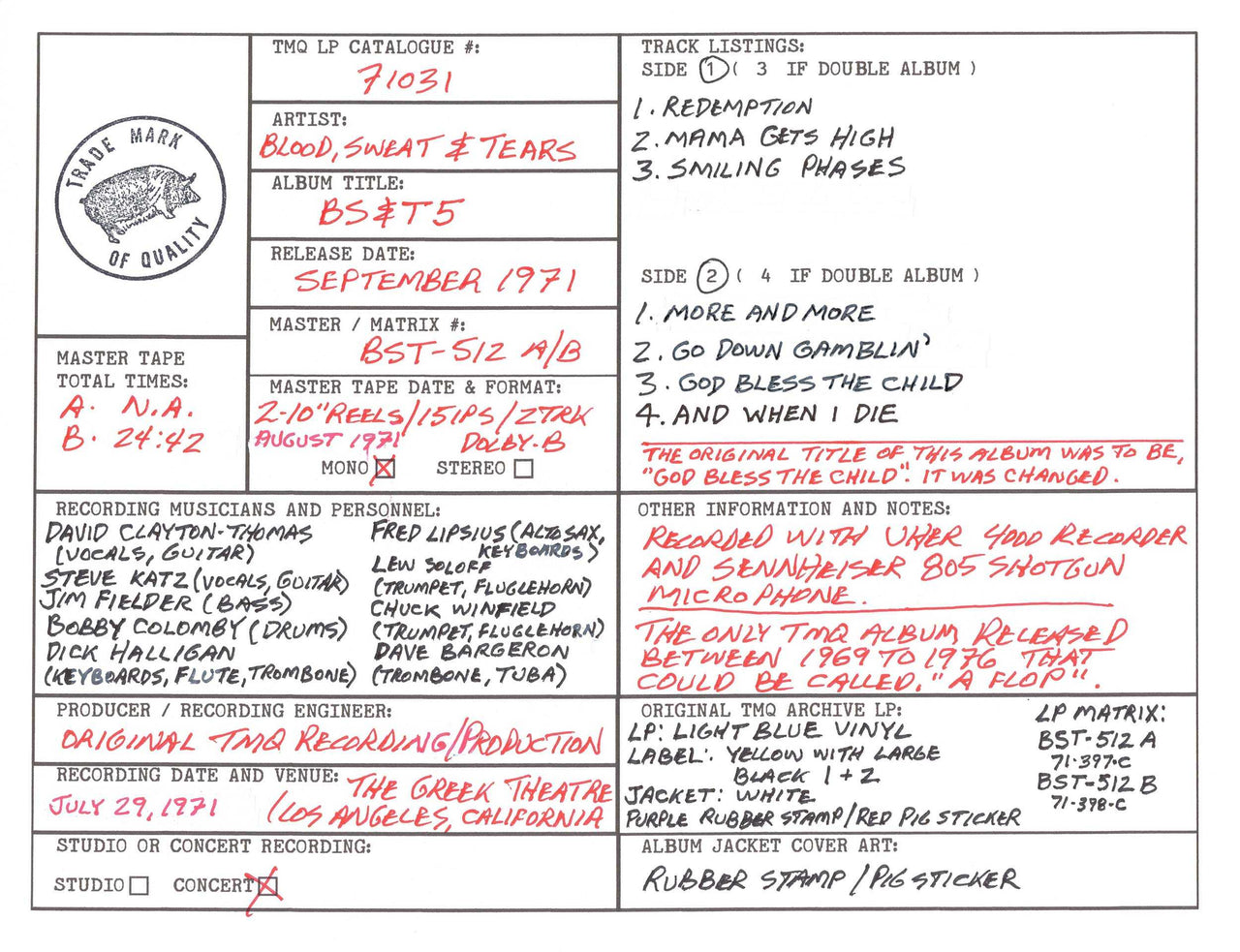
These information documents for each of the official Trade Mark of Quality releases includes the known details for each genuine TMQ title. This includes the TMQ catalogue number, artist, record title, track list, musicians, venue, recording date, master tape and record matrix info and the other particulars for each album.
In the glitz and glamour of 1960s Hollywood, Jay Sebring stood as an icon of innovation and style. A visionary who invented men's hair care and design concepts, Sebring wasn’t just a hairstylist—he was the architect of a $100-billion-a-year industry. His revolutionary techniques and signature charm drew legends like Frank Sinatra, Steve McQueen, and Paul Newman to his chair, making him a trusted confidant to Hollywood’s elite. From inauspicious roots in Michigan to Hollywood's "star among the stars," Jay Sebring embodied the American Dream.
Yet, in a cruel twist of fate, his extraordinary legacy was overshadowed by the horrifying Manson Family murders. Instead of being remembered for his groundbreaking work and larger-than-life personality, the media painted Sebring as a symbol of Hollywood’s so-called decadence—a distortion that served salacious narratives and tarnished his name.
Jay Sebring….Cutting to the Truth, now illuminated through exclusive insights from Sebring’s family, collaborators, legal and forensic authorities, and criminal perpetrators, reveals the man behind the myth. Discover how Jay Sebring’s influence lives on, shaping our culture in ways we often take for granted. It’s time to reclaim his legacy from the shadows of his tragic end and celebrate the dazzling contributions that made him a Hollywood pioneer and historical figure.
Thirtieth Anniversary Edition of the first book to expose the Titanic cover-up.
Over 500 pages, illustrated, thoroughly indexed, with a full color hardcover option, this is the book TITANIC aficionados have been waiting to own for 30 years.
In over 100 years there have been literally thousands of books written on the catastrophic maiden voyage of the RMS TITANIC. And yet, questions, myths, and lies still persist about that fateful night.
Why was the TITANIC on a route that put her in the most perilous of ice-congested sea lanes?
Why did TITANIC choose not to launch regulation distress rockets in her effort to summon help?
Why did TITANIC turn away a German ship in favor of a British rescuer?
How did a fire in the ship’s forward bunkers impact the structural integrity of the ship?
Above all, how did an impending World War and the deteriorating relationships between Britain, Germany, and the United States—largely over the merchant domination of the world’s shipping lanes—set forth an unbreakable chain of events that put the TITANIC two and a half miles beneath the surface of the North Atlantic, taking her captain, her logbook, and the truth with her?
As TITANIC: Sinking the Myths meticulously demonstrates, the real root cause of the disaster was greed, multiplied by an imperative schedule, and wrapped up in a conspiracy to cover up White Star’s policy to put profits over the lives of the passengers.
Thirty years ago, in this book’s first edition, Diana Bristow unraveled the myths to give the original, no-stone-unturned account of the events that led up to—and followed—the sinking of the TITANIC. Bristow goes right to the heart and source of the campaign of deception that served only one purpose, to protect J.P. Morgan, the White Star Line, and all their investors from astronomical liability and financial ruin if the captain, crew, or management were found negligent in the events that led to the sinking of the TITANIC. Never before had any researcher ever so deeply studied the rules, laws, regulations, and economic and political factors that ultimately led to the deaths of 1,500 people.
Bristow’s long-sought-after book, out of print for thirty years, is now presented here in an updated edition.
Once you’ve read TITANIC: Sinking the Myths, you will understand why it’s the first—and last—book you ever need to read about the most infamous maritime disaster in peacetime history.
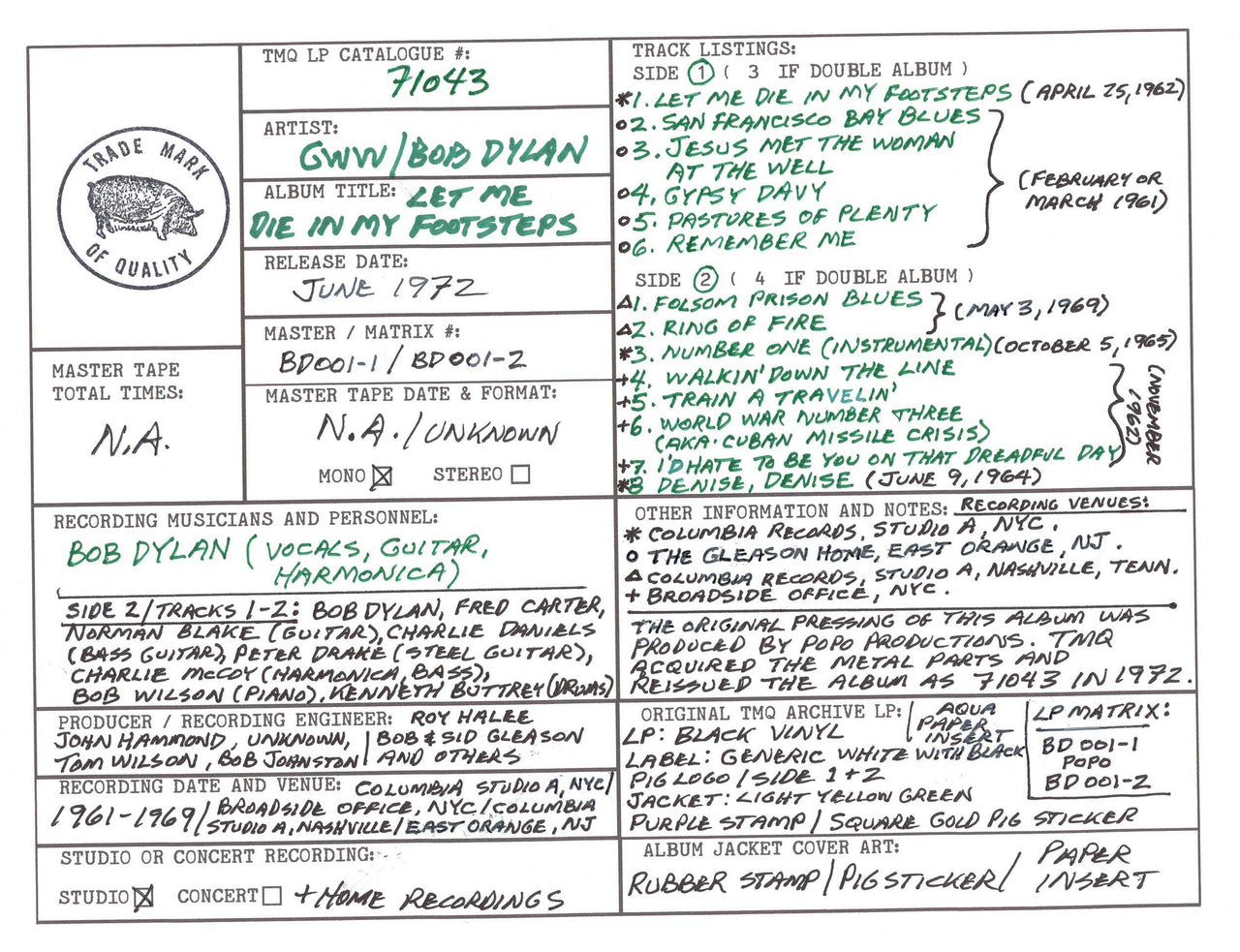
These information documents for each of the official Trade Mark of Quality releases includes the known details for each genuine TMQ title. This includes the TMQ catalogue number, artist, record title, track list, musicians, venue, recording date, master tape and record matrix info and the other particulars for each album.
Discover the songs and the history of one of the most successful pop rock bands ever, The Turtles, who had many, many Top 40 hits including “It Ain’t Me Babe,” “Let Me Be,” “You Baby,” “She’d Rather Be with Me,” “You Know What I Mean,” “She’s My Girl,” “Elenore,” “You Showed Me” and of course, the iconic “Happy Together!” All of their Golden Hits!
Authors Mark Arnold (Long Title: Looking for the Good Times; Examining The Monkees Songs, One by One and Headquartered: A Timeline of The Monkees Solo Years) and Charles F. Rosenay!!! (The Book of Top 10 Beatles Lists and The Book of Top 10 Horror Lists) have joined forces to cover the entire careers of The Turtles from their early days as The Crossfires, through their hit-filled years, into their break-up that led to most of The Turtles’ members joining forces with Frank Zappa’s Mothers of Invention, to Mark Volman and Howard Kaylan’s years as solo artists under the guise of Flo & Eddie, and even their forays into children’s records.
Arnold and Rosenay!!! have reviewed every song and album, and interviewed many of The Turtles’ friends and associates along with most of The Turtles themselves, who have given startling new revelations that will surprise even the most hardcore fan.
Open the doors to the Rock & Roll Hall of Fame and to your library to add this book. This definitive Turtles compendium is as unique as The Turtles themselves.
Every hero has a beginning, and for Ted Prichard, his was on a tiny 10-watt college radio station in Southside, Virginia. Known to his fans as Thrashpie, Thrasher, Rock ‘N’ Roll Ted, Uncle Lee, or the Dream Merchant, Ted’s career led him from overnight weekend air shifts broadcasting to the “night people” of the deep South to standing on stage at the Los Angeles Coliseum in front of 80,000 screaming metalheads as one of the most beloved radio personalities in the 1980s and ‘90s.
Head Bangin’ Radio is an exciting memoir of the era of FM rock radio at Los Angeles’s flagship heavy metal station, KNAC-FM, through the days of Pirate Radio and beyond. For fans of heavy metal, those nostalgic for the great days of rock radio, or anyone who wants a good laugh at the absurdity of show business (and Thrasher himself!), Head Bangin’ Radio delivers. If you ever wondered what it was like to be on the radio, or just what the heck those people were really doing “in there” as you listened, Ted lets it all hang out, blemishes and all, with humor and love for a medium that is all but gone today.
You are not bad at meditation. You were just given instructions for someone else’s mind.
Maybe you’ve tried to meditate and ended up frustrated. Your mind raced. Your body wanted to move. The guided voice told you to picture a beach, a garden, or a golden light, and all you saw was blank darkness.
Maybe you decided meditation works for other people.
Andrea Thorfinson knows that feeling. Living with aphantasia, she could not rely on the visualizations so many meditation practices assume. Stillness did not come easily. Calm did not arrive on command. But when she stopped trying to force her mind to work like everyone else’s, meditation finally opened.
Living Is Easy With Eyes Closed is a practical, compassionate guide for people with busy, blank, or wandering minds. Inside, you’ll find meditation techniques that do not require mental images, perfect stillness, spiritual performance, or hours of silence. Through breath, sound, movement, touch, nature, gratitude, mantra, art, and everyday awareness, Andrea offers adaptable practices for real brains in real lives.
Stillness is optional. Presence is the practice. No mental pictures required.
This book is especially useful for readers who:
struggle to visualize (Aphantasia)
have ADHD or a fast-moving mind
feel anxious, restless, or overwhelmed
find traditional meditation intimidating
need short, sensory, body-based ways to begin
want a practice that feels kind instead of corrective
Meditation is not about clearing your mind, sitting perfectly still, or becoming someone else.
It is about learning how to return to yourself.
Open the pages. Close your eyes. Begin where you are.
“Andrea Thorfinson used meditation to turn her life around. In this clear, comprehensive, eminently practical, and oh-so-helpful book, she shows you how to do the same. Her writing is infused with love, insight, and compassion. For anyone who has struggled with or just wondered about meditation, this book shines as a valuable resource.” —Robert Schwartz, author of Your Soul’s Plan, Your Soul’s Gift, and Your Soul’s Love
<title>Chapter 4: Morning Light: A Gratitude Practice to Begin Your Day</title>
<link rel="stylesheet" type="text/css" href="css/style.css"/>
<link rel="stylesheet" type="text/css" href="css/media.css"/>
</head>
<body>
<div id="chapter-4" class="element element-bodymatter element-container-single element-type-chapter element-with-heading element-with-heading-image" role="doc-chapter" epub:type="chapter">
<div class="heading heading-container-single heading-size-full heading-format-full heading-alignment-flexible heading-with-image">
<div class="heading-contents chapters-separate-number-and-title">
<div class="title-subtitle-block title-block-with-element-number">
<div class="element-number-block">
<div class="element-number case-mixed"><span class="ttext"><span class="element-number-term">Chapter</span> <span class="element-number-number">4</span></span></div>
</div>
<div class="title-block">
<h1 class="element-title case-mixed font-variant-normal"><span class="ttext">Morning Light: A Gratitude Practice to Begin Your Day</span></h1>
</div>
</div>
<div class="heading-image-block heading-image-aspect-tall heading-image-block-after-title-and-subtitle">
<div class="heading-image-size-container heading-image-width-204">
<img src="images/depositphotos_220295112_xl-3.jpg" alt="" class="heading-image-image"/>
</div>
</div>
</div>
</div>
<div class="text" id="chapter-4-text">
<div class="alignment-block alignment-block-align-center">
<div class="text-block">
<p class="alignment-block-content alignment-block-content-center"><i>“The more you are grateful for what you have, the more you will have to be grateful for.”</i></p>
<p class="alignment-block-content alignment-block-content-center"><i>~ Zig Ziglar</i></p>
</div>
</div>
<p class="first first-in-chapter first-full-width first-with-first-letter-t"><span class="first-letter first-letter-t first-letter-without-punctuation">T</span>his is one of my favorite chapters. Here we will dive into the power of starting your day with intention and how a simple morning gratitude practice can set the tone for everything that follows. You’ll see how this small ritual can shift your mindset, lift your energy, and help build emotional resilience as you move through the day.</p>
<p class="subsq">We’ll also explore how gratitude actually affects the brain, why it can be especially grounding for people with aphantasia or ADHD, and how to make the practice feel personal and real, so it works <i>for you</i>, not just in theory.</p>
<h2 id="subhead-1" class="section-title subhead level-1 keep-with-next paragraph-follows case-mixed font-variant-normal"><span class="ttext">Beginning Your Day with GratitudeAnd The Ripple Effect</span></h2>
<p class="first first-after-subhead">What better way to start your day than with a little gratitude, and maybe even a smile?</p>
<p class="subsq">If your morning routine looks anything like mine did in early adulthood, this might sound familiar: hitting the snooze button over and over, groaning, pulling the covers over my head, and wishing it were Saturday. Eventually, I’d drag myself out of bed, only to realize I’d overslept—again. Sound familiar?</p>
<p class="subsq">Chaos ensued as I frantically threw on clothes, hurriedly brushed my teeth, grabbed a stale bagel, and rushed out the door. Definitely not the ideal way to begin the day.</p>
<p class="subsq">The energy we start our morning with tends to stay with us. If we begin the day feeling stressed, scattered, or frustrated, that mood can follow us, shaping how we think, how we interact, and how we experience everything that comes next.</p>
<p class="subsq">Have you ever noticed how some people seem to light up a room just by walking into it? Their energy feels warm and magnetic, uplifting everyone around them, often without saying a word. On the other hand, you’ve probably also felt the weight of a tense room after an argument (even if you weren’t part of it), or how spending time with certain people can leave you completely drained.</p>
<p class="subsq">That’s the ripple effect of energy in action. The way we feel, what we’re thinking, what we’re carrying, it doesn’t just stay with us. It shows up in how we speak, how we listen, and how we move through the world.</p>
<p class="subsq">And the people around us can feel it.</p>
<p class="subsq">We’re always putting something out there, even if we’re not saying a word. Whether it’s calm, kindness, tension, or frustration. Our energy has a way of reaching others.</p>
<p class="subsq">Starting your morning with a gratitude meditation can set the tone for how the rest of your day unfolds. It’s a simple practice, but one that can shift your mindset, calm your nervous system, and help you move through your day with more grace and positivity.</p>
<p class="subsq">When you take time to notice what’s already good, already working, you start the day rooted in presence rather than pressure. It softens the nervous system, opens the heart a little wider, and helps you meet whatever comes with more ease.</p>
<p class="subsq">Gratitude in the morning doesn’t have to be complicated. It’s not about pretending everything’s perfect. It’s about pausing long enough to recognize what’s already good in your life, what’s steady, what’s working, or even just what feels okay in this moment.</p>
<p class="subsq">That’s why so many people come back to this kind of practice. It doesn’t just help you feel better in the moment; it shapes the energy you carry into everything else.</p>
<p class="subsq">I know what some of you are thinking: <i>“I'm not a morning person!”</i> I get it, neither am I. But I'm not asking for a long, involved meditation session, just 10 to 15 minutes to start your day with gratitude and a smile. This simple practice can have a profound impact on your overall well-being, physically, mentally, emotionally, and spiritually.</p>
<h2 id="subhead-2" class="section-title subhead level-1 keep-with-next paragraph-follows case-mixed font-variant-normal"><span class="ttext">My Journey: From Negativity to Morning Joy</span></h2>
<p class="first first-after-subhead">I say these words from experience. For a large portion of my life, I battled depression and anxiety. The idea of starting each day with gratitude would have seemed not just challenging but almost laughable. I lived more in a <i>“woe is me”</i> mentality than in the reality of how beautiful life could actually be. Shifting my focus, even slightly, changed everything. Even so, I found it challenging in the beginning.</p>
<p class="subsq">My journey with gratitude didn’t begin in the morning, it couldn’t have. For one, I wasn’t a morning person . But more than that, I was stuck in patterns of negative thinking, and at the time, it felt hard to see a way out of them.</p>
<p class="subsq">And yet there was something inside me ready to try. Even though I didn’t feel particularly hopeful, I had this quiet sense that there <i>had</i> to be a better way.</p>
<p class="subsq">This is where gratitude started to change things for me. Not overnight. Not dramatically. But slowly, it helped shift my focus. It gave me something to reach for, a way to find light even when things felt heavy. A way to recognize the good that was in my life, rather than constantly focusing only on the “bad” or negative.</p>
<p class="subsq">My personal gratitude practice started as a simple evening practice: writing down three things I was grateful for each day. And let me be completely honest with you, some days, one of those three things was literally, “I'm grateful today wasn't as crappy as yesterday!”</p>
<p class="subsq">Yes, that was really something I wrote down. And you know what? That was okay. It was honest, and it was a start. Here’s the thing about gratitude: It doesn’t have to be deep or profound or even particularly positive at first. It just has to be real.</p>
<p class="subsq">As I stuck with this practice, something began to shift. Those simple, sometimes sardonic gratitude notes gradually deepened into more heartfelt reflections. Before long, I found myself effortlessly listing more than three things and actually <i>looking forward</i> to this moment of reflection. And then I had a thought that changed everything: <i>If ending my day with gratitude could make this much of a difference... what would happen if I started my day the same way?</i></p>
<p class="subsq">What happened next?</p>
<p class="subsq">I actually started enjoying my mornings. Instead of waking up sluggish and grumpy, I found myself smiling before my feet even hit the floor. That small shift changed everything, it set the tone for the whole day. My mornings felt lighter. My days felt more hopeful. Even joyful at times.</p>
<p class="subsq">And I wasn’t the only one who noticed. Friends and family started picking up on my new energy. People I’d known for years began asking what had changed. New people began showing up in my life. People who felt lighter, more positive, and more aligned. And then one day, someone called me their “positivity coach.”</p>
<p class="subsq">Me. The same person who once had lived in doom-and-gloom mode for so long, who honestly thought life just kind of sucked most of the time, was now being described as a positivity coach. I had to laugh. But the truth is, it wasn’t about pretending to be happy or forcing positivity. It was about presence. It was about choosing gratitude, again and again, and letting that choice slowly change me.</p>
<p class="subsq"><i>Remember that ripple effect we talked about earlier? The way your energy affects everything around you?</i></p>
<p class="subsq">This is where it starts.</p>
<p class="subsq">When you begin your day with gratitude, you’re not just changing your mood. You’re choosing to connect with something deeper, something steadier. And that shift? It doesn’t stop with you.</p>
<p class="subsq">Your energy moves. It shows up in your tone, your presence, and your choices. It quietly impacts the people you talk to, the spaces you walk into, even the way you respond to challenges.</p>
<p class="subsq">You may never see the full effect, but it’s there. And that’s where real transformation begins, with one small, intentional moment that ripples outward.</p>
<p class="subsq">While the effects of gratitude can be measured in brain chemistry and nervous system patterns, many spiritual traditions have long taught what science is now beginning to affirm: Appreciation opens the heart to grace. When we give thanks, we open a channel through which love, peace, and divine support can flow freely.</p>
<h2 id="subhead-3" class="section-title subhead level-1 keep-with-next paragraph-follows case-mixed font-variant-normal"><span class="ttext">The Science Behind Morning Gratitude</span></h2>
<p class="first first-after-subhead">Practicing gratitude, especially in the morning, sets off a powerful chain reaction in both our brain and body. Science shows that gratitude isn’t just a feel-good concept; it has tangible neurological and physiological effects that can shift our entire state of being.</p>
<h2 id="subhead-4" class="section-title subhead level-1 keep-with-next paragraph-follows case-mixed font-variant-normal"><span class="ttext">Neurological Impact</span></h2>
<p class="first first-after-subhead">Gratitude doesn’t just feel good in the moment, it actually reshapes our brain and body. Here’s what researchers have discovered happens when we practice it regularly:</p>
<div class="list-text-feature">
<ul class="list-type-bulleted">
<li>
<span class=""><b>Mood boost:</b> Gratitude sparks the release of dopamine and serotonin, the brain’s natural “feel-good” chemicals. These help stabilize mood, lift motivation, and give us that subtle sense of lightness.</span>
</li>
<li>
<span class=""><b>Less stress:</b> Gratitude calms the brain’s stress center (the hypothalamus), lowering cortisol and gently shifting our nervous system out of fight-or-flight and into balance (Cheng et al.,2023)</span>
</li>
<li>
<span class=""><b>Sharper focus:</b> It also strengthens the part of the brain linked with decision-making, learning, and emotional balance (the medial prefrontal cortex). This means gratitude doesn’t just change how we feel, it supports clarity, resilience, and better choices (Kini et al., 2022).</span>
</li>
</ul>
</div>
<p class="subsq">Science is now confirming what many wisdom traditions have said for centuries: gratitude doesn’t just lift the heart, it rewires the mind to notice more good, more often.</p>
<h2 id="subhead-5" class="section-title subhead level-1 keep-with-next paragraph-follows case-mixed font-variant-normal"><span class="ttext">Why Combining Meditation and Gratitude Works</span></h2>
<p class="first first-after-subhead">Gratitude meditation is especially powerful in the morning. Your mind is still soft from sleep, not yet pulled in a dozen directions. That’s why gratitude lands so powerfully here: it has room to sink in before the day speeds up.</p>
<p class="subsq">When you pair gratitude with meditation, you’re not just <i>thinking</i> about what you’re grateful for, you’re letting yourself <i>feel</i> it. Sitting with that warmth for even a few minutes helps it settle deeper into your body and nervous system.</p>
<p class="subsq">The more often you do this, the more natural it becomes. Gratitude starts showing up on its own, like a habit you didn’t even mean to build. Over time, you may notice you’re spotting little joys without effort: a kind word, sunlight through a window, a pause that feels like grace. That’s when you know the practice is starting to live in you.</p>
<p class="implicit-break scene-break"></p>
<p class="first first-in-section first-full-width">I don’t often issue challenges, but I’d like to invite you to try the exercise below for 30 days. Why? Because, after a month of practicing a morning gratitude meditation, I truly believe you'll experience its transformative effects and feel inspired to continue.</p>
<p class="subsq">The best part? You can do it right from the comfort of your bed. No extra effort required, just a few deep breaths, a gentle smile, and a moment of appreciation to start your day on the right foot.</p>
<h2 id="subhead-6" class="section-title subhead level-1 keep-with-next format-follows case-mixed font-variant-normal"><span class="ttext">How to Practice Morning Gratitude Meditation</span></h2>
<div class="list-text-feature">
<ul class="list-type-bulleted">
<li>
<span class="">Set your alarm for 15 minutes earlier than usual. Just 15 minutes, no big deal!</span>
</li>
<li>
<span class="">For this exercise, you can stay right where you are, cuddled up and lying in bed. Or if you prefer, you can sit up before you begin. Just find a comfortable position that you can maintain for the next few minutes.</span>
</li>
<li>
<span class="">I like to add a little music to my practice. I keep my earbuds right next to my bed so they’re easy to grab. Before I begin, I pop them in and choose a piece that feels both calm and uplifting, usually something instrumental, without lyrics, so it doesn’t pull my mind into a story. A few of my go-to favorites are <i>Weightless</i> by Marconi Union (scientifically shown to reduce anxiety), <i>Expansion </i>by Karunesh, or simple piano tracks like those by Ludovico Einaudi. When I’m ready, I hit play and begin</span>
</li>
<li>
<span class="">Settle into a comfortable position. Take three long, deep breaths, filling your belly and releasing with a sigh, letting go of any lingering tension from the night.</span>
</li>
<li>
<span class="">Gently close your eyes and allow a small smile to spread across your face. It doesn’t have to be a big grin, just a gentle, natural smile. Notice how it feels in your body.</span>
</li>
<li>
<span class="">Reflect on gratitude. Think of three things you’re grateful for. These can be something big or small. It could be the warmth of your bed, a friend who makes you laugh, or the simple fact that you’re alive and breathing.</span>
</li>
<li>
<span class="">Check in with yourself. How do you feel now? Has your smile grown? If gratitude had a physical sensation, how would you describe it?</span>
</li>
<li>
<span class="">Next, deepen the practice a bit by bringing to mind someone you love, someone who lifts your spirit, makes you smile, or simply makes life a little brighter. Let gratitude for them fill your heart.</span>
</li>
<li>
<span class="">Now, take a deep breath and imagine sending that love outward, as if you were wrapping them in warmth and love. Hold on to that feeling for a moment. Next bring your hands up and gently place them on your heart.</span>
</li>
<li>
<span class="">With your hands still on your heart, let that love and gratitude flow inward, filling you with warmth. Take a moment to appreciate yourself for showing up and beginning your day with intention.</span>
</li>
<li>
<span class="">Gently open your eyes and move your body. Stretch, yawn, or simply take a moment to bask in the peace you’ve created.</span>
</li>
<li>
<span class="">(Optional) You may wish to journal about your experience. How did it make you feel? Was it easy or difficult? Or just jot down the three things you called to mind that you found to be grateful for. Writing it down deepens the reflection and helps anchor the practice in your nervous system. It’s a physical act of commitment, telling your brain, “This matters.” A bonus to journaling is that reading it later lets you witness your growth. After a few weeks of this practice, go back and look at your earlier entries. Do you notice any changes? Perhaps you’re now able to list five things you’re grateful for?</span>
</li>
</ul>
</div>
<p class="first">This moment of connection, both inward and outward, is a powerful way to set the tone for your day.</p>
<p class="subsq">Consider this a sacred morning offering to yourself. Even if only for a few moments, this time can become a daily ritual of alignment, a quiet communion with your higher self as you gently begin your day.</p>
<p class="subsq">The more we reflect on what we have in life to be grateful for, the more it sharpens our awareness. The more we practice truly being here, the more we see the treasure hidden in each moment. You may start to notice more moments that bring comfort or joy. Small things you once overlooked. A parking spot that opens just when you need it. A kind word from a stranger. A timely text message. The more often you notice, the more these moments seem to multiply.</p>
<h2 id="subhead-7" class="section-title subhead level-1 keep-with-next paragraph-follows case-mixed font-variant-normal"><span class="ttext">Adapting Gratitude Meditation for Busy Mornings</span></h2>
<p class="first first-after-subhead">Of course, life often likes to keep us on our toes and does not always unfold as planned. Maybe you’ve overslept, or you have kids to get ready for school, a demanding job, or you’re just not naturally a morning person. If a morning gratitude meditation simply is not possible for you, that’s okay! Gratitude doesn’t require perfect conditions; in fact, it can thrive even in the small moments that can easily be woven into your routine.</p>
<p class="subsq">If time is tight, remember that gratitude can happen anywhere. You can reflect on what you’re grateful for while showering, getting dressed, making breakfast, commuting, or even brushing your teeth. The key is not in finding extra time; it’s bringing gratitude into what you’re already doing. Each small moment of appreciation, no matter how brief, raises your vibration and sets a more positive tone for the day. Even when I'm feeling rushed or overwhelmed in the morning and lack the time or patience for a structured gratitude meditation, I don't let that stop me. For me, the shower is a perfect time to reflect on what I’m grateful for. While I’m washing away the day before, I’m filling my morning with positive energy.</p>
<h2 id="subhead-8" class="section-title subhead level-1 keep-with-next paragraph-follows case-mixed font-variant-normal"><span class="ttext">Why Even Small Gratitudes Matter</span></h2>
<p class="first first-after-subhead">Some days, gratitude may feel forced or inauthentic. That’s completely normal. On those days, start with the obvious:</p>
<div class="list-text-feature">
<ul class="list-type-bulleted">
<li>
<span class=""><i>I have a roof over my head.</i></span>
</li>
<li>
<span class=""><i>I can breathe.</i></span>
</li>
<li>
<span class=""><i>I have access to clean water.</i></span>
</li>
<li>
<span class=""><i>I woke up today.</i></span>
</li>
</ul>
</div>
<p class="subsq">And if even that feels like a stretch, acknowledge the struggle. It’s okay to be grateful that <i>this day will eventually end.</i> You can be thankful for small comforts, such as your favorite tea, a song that lifts your mood, or the warmth of a blanket. Some days, resilience itself is something to appreciate. The goal isn’t to force positivity but to allow space for gratitude. Even the smallest acknowledgment of something good counts.</p>
<h3 id="subhead-9" class="section-title subhead level-2 keep-with-next paragraph-follows case-mixed font-variant-normal"><span class="ttext">Deepening Your Gratitude Practice</span></h3>
<p class="first first-after-subhead">As your gratitude practice develops, you may want to explore different ways to deepen your connection to it. You might keep a gratitude journal by your bed that you look back on at the end of a month or a year. Or you can create a gratitude jar. Then on a small slip of paper jot down what you found to be grateful for that day and place it in your jar. At the end of the year dump the jar out and look back at what a beautiful year you had. Both of these techniques can help you deepen your practice in a tangible way.</p>
<p class="subsq"><b>Tips:</b> You may wish to date each of the slips of paper. Or some people find joy in capturing gratitude through photos, preserving little reminders of what makes them happy.</p>
<p class="subsq">Expressing gratitude to others is another way to expand your practice. Writing a gratitude letter (even if you never send it), saying thank you more often, or sharing your appreciation with family and friends can strengthen your relationships and amplify the ripple effect of gratitude. You may also find that combining gratitude with other mindfulness practices like deep breathing, body awareness, or loving-kindness meditations add even more depth.</p>
<h3 id="subhead-10" class="section-title subhead level-2 keep-with-next paragraph-follows case-mixed font-variant-normal"><span class="ttext">The Healing Power of Expressed Gratitude</span></h3>
<p class="first first-after-subhead">About a month into my gratitude practice, I decided I wanted to expand it. I began by simply telling the people around me how much I appreciated them, how grateful I was for all they did. Then I took it a step further: I decided to write a letter to my foster parents.</p>
<p class="subsq">But before I could, I had to forgive myself.</p>
<p class="subsq">The truth is, I had shut them out years earlier. They had opened their home and hearts to me at a time when I was vulnerable and lost, and I didn’t know what to do with that kind of love. So, in fear, I ran. I regretted it almost immediately but was too ashamed to turn back.</p>
<p class="subsq">By the time I was ready to own that mistake and ask for forgiveness, I believed I had no way of finding them. Still, I needed to say it, even if only for myself. The gratitude I carried had grown too big to hold in.</p>
<p class="subsq">I poured my heart into that letter.</p>
<p class="subsq">I thanked them for taking me in when I felt unlovable and abandoned. For offering the unconditional love I’d always craved, and for being a light in one of the darkest periods of my life. Because I didn’t think they’d ever see it, I didn’t hold back. I wrote from the soul, not for a reply, but to honor the impact they’d had on me. Their love and kindness had stayed with me, even years later.</p>
<p class="subsq">And then something unexpected happened: a few months later, I found them. They weren’t nearby—they’d moved to Nicaragua—but I found them. And not only did we reconnect, I was able to apologize, receive their forgiveness, and most meaningfully, read that letter to them out loud.</p>
<p class="subsq">That moment became one of the most healing experiences of my life. To speak those words and have them truly received washed over all three of us like a wave of peace. Since then, we’ve stayed in close contact, sharing near-daily video chats and a renewed relationship I never thought possible.</p>
<p class="subsq">Gratitude expressed like that, especially when it’s vulnerable or long overdue, can heal us in ways we never imagined. And often, it turns out to be exactly what we need to move forward.</p>
<p class="subsq">The beauty of gratitude is that it’s adaptable. There’s no single right way to practice, only what works for you. Whether it’s a silent thought in the morning, a shared moment with a loved one, or a journal entry at night, every act of gratitude strengthens the habit. Over time, it shifts from being something you <i>do</i> to something you <i>live</i>.</p>
<h3 id="subhead-11" class="section-title subhead level-2 keep-with-next paragraph-follows case-mixed font-variant-normal"><span class="ttext">Micro-Meditations: Weaving Gratitude into Everyday Life</span></h3>
<p class="first first-after-subhead">Of course, you might be thinking, <i>“If I’m just listing things I’m grateful for while brushing my teeth, is that really meditation?”</i> The answer is yes, in a way, it is. While it may not fit the traditional image of sitting in silence with your eyes closed, it aligns with the essence of meditation: <b><i>intentional presence and awareness.</i></b></p>
<p class="subsq">In fact, many mindfulness traditions encourage integrating meditation into daily life, rather than limiting it to dedicated sit-down sessions. When you consciously focus on gratitude while brushing your teeth, commuting, or making coffee, you are engaging in a form of <i>meditative awareness.</i> You’re directing your attention, shifting your mental state, and cultivating mindfulness—all core aspects of meditation.</p>
<p class="subsq">Small, intentional pauses throughout the day can be just as impactful as a formal meditation session. The key is <i>how</i> you do it with awareness, presence, and an open heart. Over time, these micro-meditations become second nature, transforming everyday moments into opportunities for peace, gratitude, and connection. And when that happens, the effects don’t just stay within you, they ripple outward.</p>
<p class="subsq">By inviting gratitude into your daily life, you’ll begin to see the simple joys that were always there but may have gone unnoticed before, the tiny wins and quiet gestures that bring comfort or happiness. Maybe your spouse crossed something off your to-do list, traffic lights lined up green when you were running late, or you took a hot shower at the end of a long day. These ordinary wins begin to stand out and soon, they’ll naturally find their way on to your daily gratitude list.</p>
<p class="subsq">Remember my story about starting with evening gratitude and barely being able to list three things?</p>
<p class="subsq">These days, gratitude has become such a natural part of my life that I rarely struggle to find things to be grateful for. In fact, I often tick off twenty or more without even blinking!</p>
<p class="subsq">One thing I’m deeply grateful for is this: Since beginning my meditation practice and intentionally incorporating gratitude, my depression has lifted. I haven’t needed antidepressants in several years, and I haven’t had a single anxiety attack in over three.</p>
<p class="subsq">I’m not claiming these results will be typical for everyone, and I’m certainly not suggesting that anyone stop taking prescribed medications.</p>
<p class="subsq">But it is my wholehearted belief that meditation and gratitude can open you up to more positive energy, greater emotional balance, and a sense of inner peace. Over time, this energy will gradually permeate every aspect of your life, quietly, steadily, and powerfully altering your reality from within.</p>
<p class="subsq">At the end of the day, take a moment to reflect: What golden moments did you experience today? Allow them to bring a soft smile to your face, just as your morning gratitude meditation did. <b>This is how gratitude grows, not just as a habit, but as a way of life.</b></p>
<p class="subsq">And when you wake up tomorrow, begin again, with gratitude.</p>
<p class="subsq">Gratitude helps us open our hearts, but what do we do when life pulls us out of that space? When calm gives way to chaos, or joy feels out of reach?</p>
<p class="subsq">That’s where the next chapter begins: not with a perfectly peaceful morning, but in the raw, emotional heart of being human.</p>
<p class="subsq">Because I first experienced the power of gratitude through writing, I’ve decided to add journal prompts to some of the chapters. Starting here, I’ll offer a few simple prompts you can use to explore and reflect on what these meditations bring up for you.</p>
<h3 id="subhead-12" class="section-title subhead level-2 keep-with-next format-follows case-mixed font-variant-normal"><span class="ttext">Journal Prompts:</span></h3>
<div class="list-text-feature">
<ul class="list-type-bulleted">
<li>
<span class="">What three things are you grateful for this morning?</span>
</li>
<li>
<span class="">Did gratitude shift how you moved through your day? If so, how?</span>
</li>
<li>
<span class="">What small thing you might otherwise have overlooked ended up feeling meaningful?</span>
</li>
</ul>
</div>
<h3 id="subhead-13" class="section-title subhead level-2 keep-with-next paragraph-follows case-mixed font-variant-normal"><span class="ttext">Sounds for Gratitude</span></h3>
<p class="first first-after-subhead">In my own practice, I often bring music into my morning gratitude meditation. The right sound helps me feel grounded, calm, and open-hearted. I look for tracks that are gentle and spacious. Music that doesn’t stir up strong emotions but instead creates room for reflection.</p>
<p class="subsq">Throughout this book, I’ll share some of my favorite musical themes to help you get started. You can find similar tracks on your preferred music platform or create your own playlist inspired by these suggestions:</p>
<div class="list-text-feature">
<ul class="list-type-bulleted">
<li>
<span class="">Peaceful instrumentals that create a soft backdrop (Deuter, Liquid Mind).</span>
</li>
<li>
<span class="">Uplifting world music with a meditative quality (Karunesh).</span>
</li>
<li>
<span class="">Gentle, chant-like vocals that open the heart (Clannad, Ekaterina Shelehova).</span>
</li>
</ul>
</div>
<p class="subsq">While these are some of my favorites, I encourage you to explore and discover what feels right for you.</p>
</div>
</div>
</body>
</html>
All work and no play make Jack a dull boy. But when one of his professors offers to send American grad student Jack Farmer to Europe to do historical research in Amsterdam’s Begijnhof—a peaceful closed community in the heart of the bustling Dutch capital—Jack looks forward to a summer of mostly play and not much work. Then he meets Jet Schilders, an attractive young nurse who takes care of the elderly woman next door, and realizes that his summer in The Netherlands might just turn out to be even more fun than he'd hoped.
When the woman next door is brutally murdered, though, and her nurse turns out to be the prime suspect, Jack and Jet join forces in an attempt to find the real killer and clear her name. But their investigation puts them in Dutch with the local police, and a second murder raises the stakes … and paints a target on both of their backs.
“Dutch Threat has wit, charm, and lovely crisp prose—everything that’s great about Josh Pachter’s short fiction. His debut novel was a long time coming, and it was well worth the wait!" —Tom Mead, author of Death and the Conjuror and The Murder Wheel
Just one year after Woodstock and the Summer of Love, a new kind of music made its way onto the airwaves and into the hearts of millions of fans. The sound was dark, brooding, and overpowering, like the music of industrial machinery, with a banshee in the lead who shrieked out lyrics from the darkest parts of our souls. But the melodies had meaning, and the words pointed their finger at the injustices and corruption of the world, in the finest tradition of the music of the 1960s. This sound, this phenomenon became known as “heavy metal.”
In Black Sabbath: An Oral History, Mike Stark brings us into the world of Tony Iommi, Geezer Butler, Bill Ward, and of course, John “Ozzy” Osbourne, four young men from England who changed the world with their music. Through their own words, Stark presents firsthand accounts of the history of the quintessential British heavy metal band, who influenced later bands as diverse as Metallica, Van Halen, Nine Inch Nails, Alice in Chains, and others, right up to today.
With a supporting cast of characters that includes Ronnie James Dio, Rob Halford, Eric Singer, Tony Martin, Cozy Powell, and Neil Murray, Black Sabbath: An Oral History also provides a detailed timeline of the band from 1970 to 2017, as well as an annotated album discography.

It’s 1975, and rookie cop Edward One patrols the streets of Long Beach, California. As he gains experience as a police officer, he finds himself dealing with dangerous criminals as well as outrageously funny scenarios, learning from some of the best—and worst—officers the Long Beach Police Department has to offer. Edward One is dedicated to truth, justice, and the law, which are not always in harmony.
During this time, a twisted and violent predator who calls himself The Skulker grows deadlier with each attack. When The Skulker arrives in Long Beach, he crosses paths with Edward One, and the results are as surprising as they are deadly.
Dilemma tells the captivating tale of the dangers and joys of police work in the ‘70s and provides an insight into the corrupted thinking of a killer.
Monk’s Music, Thelonious Monk: An Illustrated Discography is the definitive and up-to-date guide to the recordings of one of the most important jazz composers and performers of the 20th century. A feast for the eye with the full color reproductions and a carefully researched and informative text, Monk’s published recordings are documented here in chronological order, from the earliest days of 1941 through his last known recorded performance in 1975.
It’s all here for the Monk fan, Jazz lover, collector and anyone interested in music and recordings. Included on these pages is all the info about Thelonious Monk’s audio and video recordings released through the years on 78rpm, LP records, compact disc, video laser disc, DVD and Blu-ray. Album covers and labels are reproduced in full color. Also included is complete information about the studio and live recording dates, musicians, track listings, record labels, producers, recording venues, bibliography and classic quotes from the High Priest of Bop himself.
From sideman pianist in the nightclubs of Harlem to world famous and iconic musical genius, this is the story of Thelonious Sphere Monk as told through his many recordings.
The zombies are here.An accidental outbreak of a mutated virus unleashes hundreds of the undead on the sleepy town of Flat Rock, Nevada. Now, Sheriff Penny Miller must use her wits, grit, and damn near all of her ammunition to endure the arrival of zombies. Sheriff Miller quickly finds herself leading a vicious biker named Scratch, her ex-husband Terrill Lee, and a unit of incompetent National Guardsmen to safety. At their heels is Colonel Sanchez, the wicked Army commander who is pursuing Miller to gain the special powers the virus has given her. With a gang of murderous bikers on their tail and surrounded by slobbering hordes, Sheriff Miller must do what she does best: Aim for the brain!
“THE HUNGRY is a zombie thriller loaded with sex and smarts. A real nail-biter that brings a new weapon to bear in apocalyptic fiction: Hope. Highly recommended.”
—Jonathan Maberry, NYT Times bestselling author of Dust & Decay and Dead of Night
“If you’re craving an apocalyptic horror novel that’s not just wall-to-wall action but balls-to-the-wall intense, Steven W. Booth and Harry Shannon have cooked up a real treat for you. I would say The Hungry will leave you totally satisfied, but that’s not true: Readers will be howling for more more more MORE just like the hordes of insatiable zombies rampaging through this book.”
—Steve Hockensmith, author of Pride and Prejudice and Zombies: Dawn of the Dreadfuls
“You don't know what gut-churning page-flipping horror really is until you read this one. The Hungry combines the storytelling power of the big commercial thriller with many new twists on standard zombie fiction. A real winner.”
—Ed Gorman, author of The Dark Fantastic and Cage of Night
"Kill Your Characters" is a critical handbook for crime writers everywhere. Imagine you have a dead body on the floor, and your detective character needs to solve the crime and catch the killer. But, if you're not an expert in forensic investigation, how can you describe the death accurately, so the clues make sense?
This book, written by former detective and forensic investigator Steve Rush, equips you with the tools you need to impress not only armchair detectives but also real ones. It's your ultimate guide to crafting a gripping opening incident for your story. No more hours wasted searching for accurate information elsewhere.
In "Kill Your Characters," you'll find an accurate guide to crucial questions like: How did your character meet their end? What were the circumstances of the murder? Which weapon did the killer use? What evidence did they leave behind? How can you build an airtight case against the suspect?
With this book, you'll have the facts to make your fiction stand out. Whether you're plotting your next murder scene or tackling challenges like determining the time of death or understanding forensic evidence from a gunshot wound, Steve Rush's extensive experience is packed into practical tips and activities that will enhance your storytelling. "Kill Your Characters" is a valuable resource for any author aiming to bring credibility and authenticity to their murder scenes.
SMITTY: My Marriage to Serial Killer Charles Schmid, the Pied Piper of Tucson unveils an unforgettable tale of love, betrayal, and survival. Diane Schmid thought she had found her Prince Charming when she met Charles Schmid, a charismatic and mysterious man who swept her off her feet as a teenager in the mid-1960s. But her fairytale quickly unraveled when her husband was arrested for multiple shocking murders that captured national attention.
Set against the backdrop of a rapidly changing America, this deeply personal memoir recounts Diane’s journey from a young girl in love to a woman facing unimaginable revelations. Through vivid memories and unflinching honesty, Diane reveals how she navigated a life overshadowed by her husband’s heinous crimes while striving to protect her family and find peace.
Written with co-author Marshall Terrill, this book offers a unique perspective on one of the most infamous cases in American history, shedding light on the devastating human cost of living with such a dark secret. Blending gripping storytelling with heartfelt reflection, SMITTY captures the strength of a survivor who chose to share her voice after decades of silence.
SMITTY is a compelling and haunting read for those who seek a deeper understanding of resilience in the face of unthinkable events.
Chicago Cop Stacey Macbeth had ended Lonnie Huggins’ reign of terror when he sent the vicious criminal to prison. Now, however, a non-for-profit team of investigators has freed him back into the real world on some trumped up allegations of misconduct on the part of Macbeth. Word on the street is that Huggins is out and looking to settle some old scores, starting with Macbeth. With innocents caught in the crosshairs, Macbeth vows once more to bring Huggins to justice, setting the stage for a head-to-head confrontation where the rule book has been hurled from the window. Both men embark on a collision course in which each is seeking his own brand of Chicago Justice, knowing that this time there will be only one left standing.

5.0from 9 readers
<?xml version="1.0" encoding="UTF-8"?>
<!DOCTYPE html PUBLIC "-//W3C//DTD XHTML 1.1//EN"
"http://www.w3.org/TR/xhtml11/DTD/xhtml11.dtd">
<html xml:lang="en" xmlns:epub="http://www.idpf.org/2007/ops" xmlns="http://www.w3.org/1999/xhtml" lang="en">
<head>
<title>Chapter 6: Motives</title>
<link rel="stylesheet"
type="text/css"
href="css/style.css" />
<link rel="stylesheet"
type="text/css"
href="css/media.css" />
</head>
<body>
<div id="chapter-6" class="element element-bodymatter element-container-single element-type-chapter element-with-heading">
<div class="heading heading-container-single heading-size-full heading-format-full heading-alignment-flexible heading-without-image">
<div class="heading-contents">
<div class="title-subtitle-block title-block-with-element-number">
<div class="element-number-block">
<div class="element-number case-mixed"><span class="element-number-term">Chapter</span> <span class="element-number-number">6</span></div>
</div>
<div class="title-block">
<h1 class="element-title case-mixed">Motives</h1>
</div>
</div>
</div>
</div>
<div class="text" id="chapter-6-text">
<h2 id="subhead-1" class="section-title subhead keep-with-next paragraph-follows case-mixed">TUESDAY 1330 Hours</h2>
<p class="first first-in-chapter first-full-width first-after-subhead first-with-first-letter-t"><span class="first-letter first-letter-t first-letter-without-punctuation">T</span>he door to the 27<sup>th</sup> Ward Alderman’s office on Chicago Avenue opened, jangling the bells behind the glass. A black man in his early thirties stepped through from the street, dressed conservatively in a navy suit. Mavis Stomps watched from the back of the room under the switched-off overhead lights. She knew who he was but had only met him once since he’d come to his church as pastor. By all accounts, people seemed to believe he ran his church in Cabrini-Green for the glory of the Almighty and no personal agenda.</p>
<p class="subsq">He was average height and weight and wore rimless glasses, and no jewelry. He had a smooth, caramel complexion and a close-cut beard matching a trimmed Afro. Everything about him was church conservative. As he stepped up to the receptionist’s desk, she saw that he carried himself with confidence.</p>
<p class="subsq">The girl working the front of the office looked up. Mavis snubbed out her cigarette on the window sill and blew the smoke toward the back of the hallway.</p>
<p class="subsq">“May I help you?” the girl said in a nasally voice that just irked Mavis to no end.</p>
<p class="subsq">“My name is Turner Galbreath. I’m here to see the alderman.”</p>
<p class="subsq">Mavis stepped from the shadows toward him. “Ah, Reverend Galbreath, thank you for coming.” She extended her hand as she got close.</p>
<p class="subsq">His manicured hand took hers, his grip strong and calloused.</p>
<p class="subsq">“Let’s go in back. We can talk.” She gestured for him to follow.</p>
<p class="subsq">Her office, paneled in dark wood, was Spartan, containing a worn desk and a couple of plastic chairs. The desk had come from another closed school, which had been another loss for her ward and her community. The plastic chairs were the white stackable variety. She led Galbreath in and shut the door before taking her seat behind the desk.</p>
<p class="subsq">“I know you’re a busy man. So I really appreciate your stopping by.”</p>
<p class="subsq">He settled into one of the chairs and looked around before nodding.</p>
<p class="subsq">Given his silence, she continued, “I have been a bit slow getting together with my ministers.”</p>
<p class="subsq">His stare bore into her as if she had his undivided, borderline hostile attention. He must be an effective preacher with a look like that. “Your ministers?”</p>
<p class="subsq">“You know, Reverend, the ministers in the ward is what I’m saying.”</p>
<p class="subsq">“I see. Please forgive my cautious nature, but I’ve been quite disappointed with public servants of late.”</p>
<p class="subsq">“Really?” She found herself wishing she’d taken the opportunity to slam a little more whiskey, but perhaps a clear mind was needed. The good reverend might prove a little challenging.</p>
<p class="subsq">Elbows poised on the arms of the plastic chair, Galbreath steepled his fingers in front of him. “As assistant chairwoman of the police/fire committee, I’m sure you’ve heard about our picketing.”</p>
<p class="subsq">“As a matter of fact, that’s why I wanted to see you.”</p>
<p class="subsq">He settled back into the chair and seemed to want her to continue, but finally went on when she didn’t. “We’ve called and left quite a few messages with your office. We’d like to see you join us on the picket line.”</p>
<p class="subsq">“Perhaps.” She weighed the option of a photo op. “But I prefer to work behind the scenes, where I can do more good as an elected official.”</p>
<p class="subsq">“That’s all well and good,” he said. “Your community would benefit by seeing you standing with us. Seeking those very same answers you say you’re looking for.” He made quote marks in the air. “Behind the scenes.”</p>
<p class="subsq">“My people know I’m at work.”</p>
<p class="subsq">“Do they?” he asked. “I can assure you that those members of our community who stand with me are skeptical.”</p>
<p class="subsq">Mavis felt her blood pressure begin to rise. “I promise you I do labor on behalf of the constituents of my ward and I don’t appreciate anyone saying I don’t.” She crossed her legs under the desk and laid her hands in her lap, to keep them from betraying her rage. “I work tirelessly for my people.”</p>
<p class="subsq">“I didn’t come to level allegations.” Galbreath smiled. “Just telling you what some of ‘your people,’”—he made the quotation gesture again—“have said in my presence. Though, I shouldn’t think an alderman as powerful as yourself cares what a few picketers think or say.”</p>
<p class="subsq">“I do care, though.” She clinched her hands in front of her face.</p>
<p class="subsq">“Don’t you see?” she said. “That’s how this mayor works, dividing the people.” She pointed at him. “First you’re out there saying the poh-leece did this or the poh-leece did that, but then slowly you start saying, ‘Where’s Alderman Stomps?’ Next thing you know, the poh-leece is all but forgotten and I’m on the hot seat.”</p>
<p class="subsq">Galbreath took a deep breath and slowly released it. “You seem a little defensive, Alderman.”</p>
<p class="subsq">“Damn right.” She stood for effect. “Damn right I’m defensive.” She quieted a little. “Wouldn’t you be? Man I invite into my inner sanctum, accuses me of sitting on my hands, letting my people down, when he don’t know jack about what I’m doing or why I asked him to stop by in the first place. But that’s how this mayor likes to divide the people. I can’t stand it and won’t put up with it.” She tried to look like she was calming herself down. “Sorry I cursed, Reverend, but I get riled up.”</p>
<p class="subsq">He watched her, like he was trying to decide to believe her or what to say, maybe both. “Okay. Why did you invite me?”</p>
<p class="subsq">“You are leading the group picketing the poh-leece and I was wondering what is it you want to know?”</p>
<p class="subsq">“It hasn’t changed since we began. We’re demanding answers about the circumstances surrounding the death of Antwan Simms.”</p>
<p class="subsq">“I know that part, IAD has reopened the investigation. But you know that, too. What else?”</p>
<p class="subsq">“What else?” The man brought a certain majesty to the plastic chair in his lack of movement.</p>
<p class="subsq">“Yes, what else are you looking for? You already know the cops have reopened the case. So that’s not what you’re protesting for. What else?”</p>
<p class="subsq">“Nothing, other than Antwan’s mother deserves to know how her son died, and the police should know already. That’s it.”</p>
<p class="subsq">“C’mon, don’t play me, Reverend. There’s always some other reason, what’s yours?”</p>
<p class="subsq">“I don’t know what you’re driving at.” His head moved very little. “You mean an ulterior motive?”</p>
<p class="subsq">“Yeah, something like that. What is it?”</p>
<p class="subsq">“I can assure you that we’re seeking answers on behalf of Ms. Collins. She’s a right to know the truth about her son’s death. We know there’s more to the story than we’ve been told, including allegations that Antwan might’ve been thrown from that building. There’s supposedly a witness. If anyone has a right to know the truth, it’s the boy’s mother.”</p>
<p class="subsq">“Okay.” Mavis settled back into her chair. The honest and righteous were pretty damned dangerous, but they could be useful. She smiled. “Good. I want to applaud what you’re doing, Reverend. In fact, I asked you in here to encourage you to continue and protest more. Maybe escalate things a little, make the poh-leece and the media recognize that you’re serious. What do you need?”</p>
<p class="subsq">“Need?”</p>
<p class="subsq">“Do you need more people? Signs? A loudspeaker? What do you need?”</p>
<p class="subsq">“I think I’ve got all we need. We’re looking for answers, not trouble.”</p>
<p class="subsq">“I bet you could use some more bodies. Everyone can use more bodies. I can provide you with those bodies. The media loves to see a crowd. I might be able to arrange a little more coverage, too. You’ve got to work with me is all.”</p>
<p class="subsq">“And you’ll be working behind the scenes?” he asked.</p>
<p class="subsq">“That’s right. The more pressure you can bring to bear on the superintendent and the mayor, the easier it’ll be for me to get your answers. And maybe even effect a little change in the process. And I will be there with you as well, tomorrow in fact.”</p>
<p class="subsq">“What are <i>your</i> ulterior motives, Alderman, if I may ask?”</p>
<p class="subsq">“Sure. Sure, you can ask, Reverend.” She sat forward and put her elbows on the table, leaning toward him like a co-conspirator. “We need to bring some change to the way the poh-leece do business in our community. If we lie down and take it, they’ll just keep on kicking us in the teeth. I think it’s going to remain open season on black people until that change comes about.” <i>Not to mention</i>, she thought, <i>getting rid of that pompous ass white superintendent and getting a right-thinking man of color to replace him</i>. Someone she could exert some control over. “I need for there to be pressure on Plumb and the mayor, both media and community pressure. If we can stir up some interest, we’ll be able to rally others to our cause and that’ll add up to even more pressure from all fronts. That’s the only thing these people respond to.”</p>
<p class="subsq">“Really? And what change is it that you hope to inspire?”</p>
<p class="subsq">“That they treat us with the respect we deserve as a community and that our rights aren’t trampled on like just some more garbage in the street. That a black man can leave his home and not be afraid of the poh-leece.”</p>
<p class="subsq">“I’m not afraid of the police,” he said. “A lot more innocent people are gunned down by gang members than by police. My issue. Well, our issue, at least the issue we’re trying to address, is about a particular incident, a particular officer, and perhaps a cover-up. I realize the police have their hands full, but on the whole, I have a lot fewer problems with them than those drug dealing, gun toting gangbangers.”</p>
<p class="subsq">“Reverend, you mean to tell me that when a poh-leece car drives by you with two white cops in it you don’t get nervous? C’mon now?”</p>
<p class="subsq">“I don’t think I’m any more likely to be stopped by white officers than by black officers.”</p>
<p class="subsq">“You’re wrong, sir.”</p>
<p class="subsq">“If anything, it’s a power thing, or a covering for one of your own when something goes wrong thing, not just a black-white thing,” Galbreath said.</p>
<p class="subsq">“Reverend,” Stomps said. “This is Chicago. Everything, and I mean <i>everything</i>, is black and white. You feel me?”</p>
</div>
</div>
</body>
</html>
The Maritime Art of James A. Flood: Passenger Ships will be releasing on December 6, 2024. Order yours now!
Embark on a voyage through history with The Maritime Art of James A. Flood: Passenger Ships. This stunning hardcover collection features 50 breathtaking paintings by James A. Flood, a celebrated artist and former Navy sailor with a lifelong connection to the sea. From his days working on tugboats to painting majestic ocean liners, Flood brings his passion and expertise to every page.
Each painting—featuring legendary vessels like the RMS Titanic and RMS Queen Mary, along with other storied liners—is accompanied by rich historical details and personal reflections from Flood. Through its vivid artwork and engaging insights, this book offers readers a glimpse into the artistry, innovation, and history of these remarkable seafaring marvels.
Perfect for art lovers, ship enthusiasts, and history buffs alike, The Maritime Art of James A. Flood: Passenger Ships is more than a book—it’s an invitation to explore the beauty and grandeur of maritime heritage.
From the artist:
Born near the bustling docks of Philadelphia, it’s no surprise that I was captivated from the very beginning by the magnificent ships that sailed by. Their beauty and engineering perfection held me spellbound, an obsession that became a lifelong passion.
I painted ship after ship, tirelessly capturing their elegance on canvas for more than 70 years. In this selection, I present my favorite passenger ships. I hope you enjoy them as much as I have cherished painting them.
When she was a little girl, a stranger used the one thing he shouldn’t have known—her father’s love of fishing—to nearly walk her out of a crowded Oklahoma bowling alley.
Her father’s scream stopped him in time. He was never caught.
Forty years later, LaDonna Humphrey—now a cold-case investigator who has spent her career searching for other people’s missing daughters—turns that same skill on her own case. She releases a composite sketch. She reopens court records. She finds men who almost fit and watches hope collapse each time a date or a location doesn’t line up.
What starts as a search for one man becomes something larger: a map of how many ordinary men moved quietly through the same small towns and how many families never got the answer she’s still chasing.
The Man at Hilltop Lanes doesn’t end with an arrest. It ends with a harder, truer question: what do you do with a story that refuses to close?
Part memoir, part cold-case file, told by a woman who has spent her life on both sides of that question.
The Man at Hilltop Lanes releases on July 17, 2026. Order yours today!
The stench of death hung in the air as John Altar studied the massacre and tried to convince himself that his younger brother, Bobby, couldn’t have been part of this. Torn apart by the Civil War, the two brothers had fought on opposite sides, and in defeat, Bobby had fallen in with a group of Confederate raiders when released from a prisoner of war camp. Their mother’s wish was for her wayward son to be brought back to her, and Altar has sworn to do it. But how much had the war changed his brother? Riding into the Dakotas, Altar must face an unsavory lawman with a rapacious posse, rampaging Indians, and finally battle the brutal renegades in a climactic showdown.
In The Parking Lot Rapist, retired detective Lee DeVore recounts the harrowing investigation that led to the capture of a serial rapist and killer who terrorized Los Angeles and Orange Counties in the 1970s. This gripping true crime narrative begins with the tragic murder of nineteen-year-old Gina Marie Tisher and delves into the relentless pursuit of justice by the Fullerton Police Department.
DeVore provides his insider's view of the complex and meticulous investigation, revealing the strategies, challenges, and breakthroughs that ultimately led to the arrest and conviction of Kenneth Richard Hulbert. Through detailed accounts of key moments, including transcripts of Hulbert's chilling confessions, collaboration with various law enforcement agencies, and the emotional toll on the victims' families, DeVore paints a vivid picture of a community united in its fight against a monstrous predator.
The Parking Lot Rapist is more than just a detective's tale; it is a testament to the dedication, teamwork, and unwavering commitment of an entire police department. This compelling story captures the essence of true crime, highlighting the painstaking efforts and sacrifices made to bring a dangerous criminal to justice.
Whether you are a true crime enthusiast or simply seeking an authentic account of law enforcement's pursuit of justice, The Parking Lot Rapist offers an unflinching look at the resilience and determination necessary to protect and serve.
In Police Pranks, Jokes, and Other Stories Not Suitable for Children, retired Long Beach (California) police officer Richard “Buz” Williams collects nearly one hundred anecdotes of pranks, gags, and other antics played by law enforcement officers on other law enforcement and on suspects. Spanning from the 1930s to the present, Police Pranks shares some of the funniest moments handed down from Williams family, including both grandfathers, his father, great uncle, and cousin (all Los Angeles PD officers), from his time in the Long Beach PD, and from stories collected from other parts of the law enforcement world.
This collection of short stories is a perfect quick read for anyone interested in law enforcement or just a good laugh.